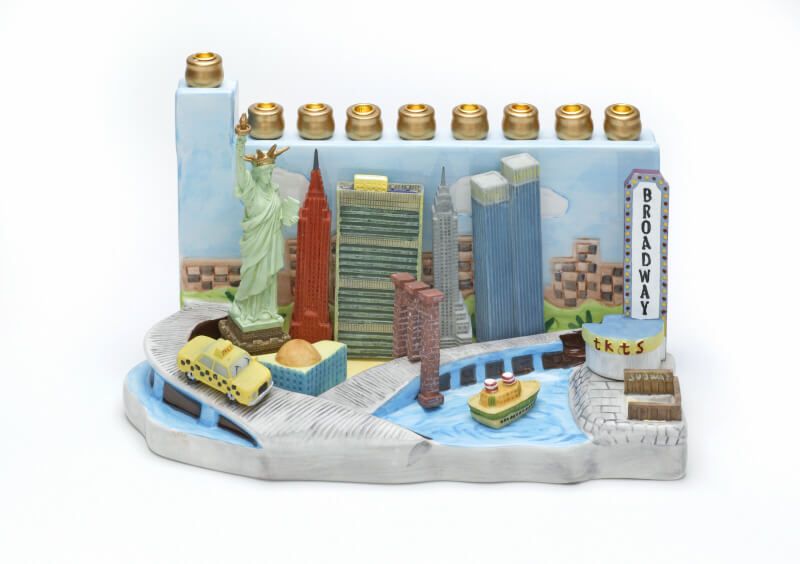
There are not many requirements for a hanukkah lamp. The basic elements are eight candle (or oil) holders arranged in a straight line. The ninth branch (called the “shamash” or “servant”) is used to light the others. The rest is up to the designer …
New York, New York

Hanukkah lamp New York City Skyline Memorial Menorah, designed by Shepsil Scheinberg; Jewish Museum Berlin, photo: Jens Ziehe
→ continue reading
The dreidel (also dreidl, dreidle, dreydel, and draydel; sevivon in Hebrew) is a spinning top used to play the traditional dreidel game during Hanukkah.
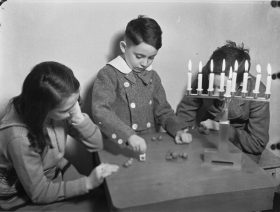
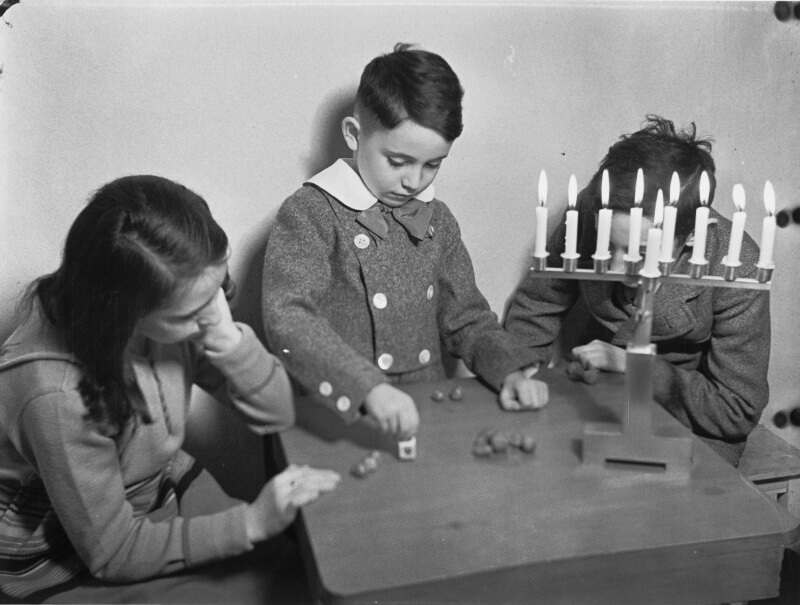
The photograph Kinder beim Trendelspiel (“Children Playing Dreidel”) was taken by Herbert Sonnenfeld in 1934 in Berlin; Jewish Museum Berlin
The four sides of the top, which is shaped like a die, bear the Hebrew letters nun, gimel, hay, and shin (or peh). These are the first letters of the words in the sentence “Nes gadol hayah sham” (or “Nes gadol hayah poh”), which means “A great miracle happened there” or “A great miracle happened here”—depending on whether the game is played in the Diaspora or in Israel. → continue reading
Latkes
Ingredients
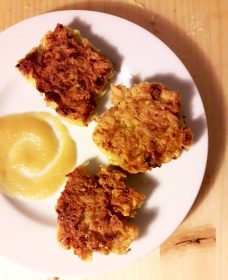
In Hebrew they are called Levivot, their Yiddish name is Latkes. For Hanukkah they are served with applesauce or sour cream; Jewish Museum Berlin, photo: Franziska Schurr
- 6 medium-large potatoes
- 1 medium onion
- 2 eggs
- 60 g of flour
- Salt and freshly ground pepper to taste
- Vegetable oil for frying
- Applesauce
- Sour cream
Instructions
Finely grate the potatoes and onion. Drain the mixture in a sieve and squeeze out as much liquid as possible. Transfer the mixture to a large bowl and add the eggs, the flour, salt and pepper, and mix until the flour is absorbed. Heat the oil in the pan. Pour the dough into the hot oil one tablespoon at a time and fry for about two minutes. When the edges of the latkes are brown and crispy, flip. Cook until the second side is deeply browned. Drain on kitchen paper. Place the latkes on a serving plate and keep warm in the oven. Serve warm with applesauce and the optional sour cream.
→ continue reading




 RSS feed
 Facebook
 Instagram
 Twitter: @jmberlin
 YouTube