Prize for Understanding and Tolerance
Every year since 2002, the Jewish Museum Berlin (JMB) and the Society of Friends and Supporters of the Jewish Museum Berlin Foundation have jointly awarded the Prize for Understanding and Tolerance.
This prize honors individuals in politics, business and culture who have made an exceptional contribution to understanding and tolerance, the promotion of human dignity, the integration of minorities and the coexistence of different religions and cultures.
The JMB publishes the current year’s prizewinner in the press section of its website.
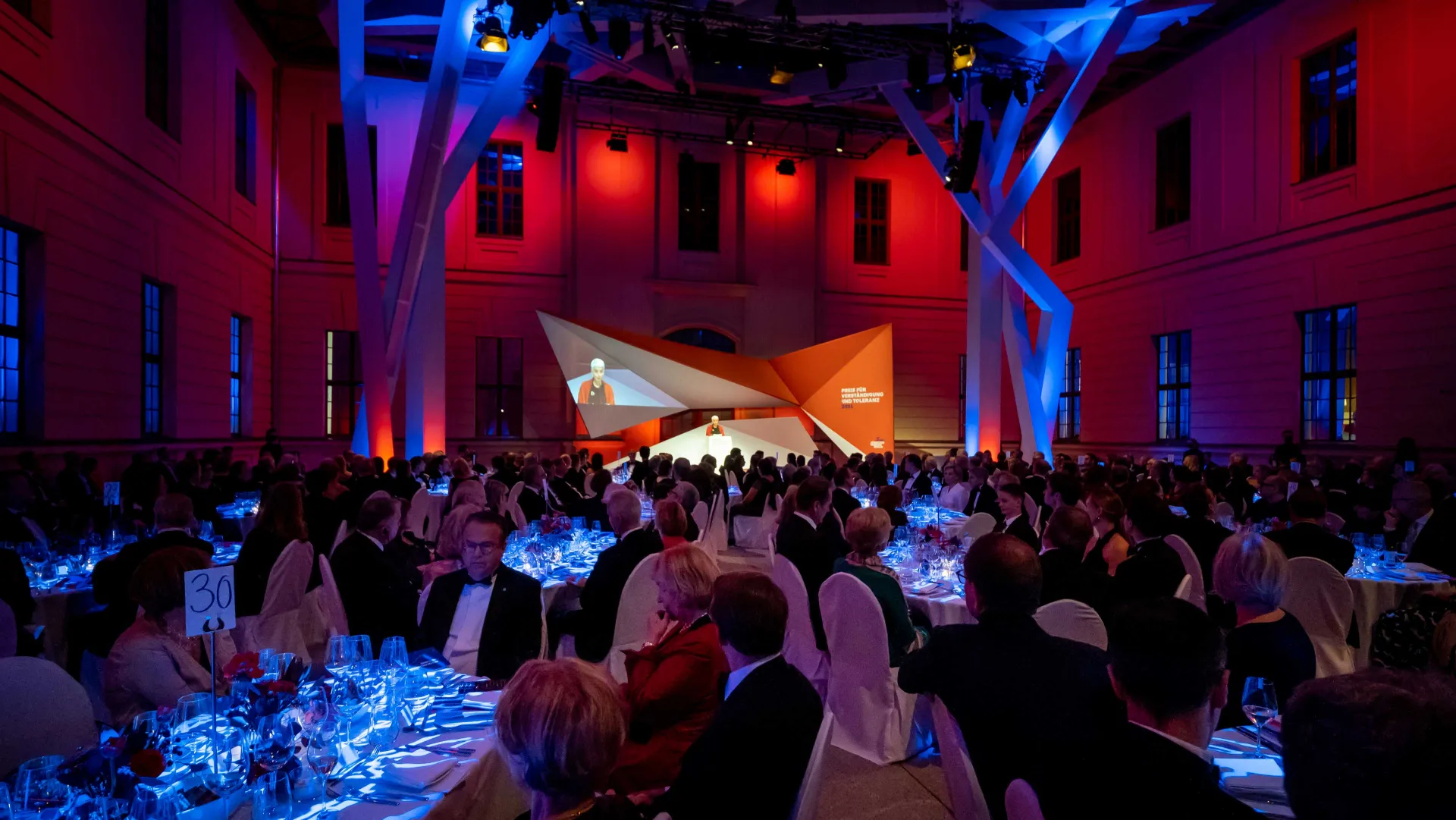
The award ceremony traditionally takes place within the framework of a gala dinner, to which the museum welcomes numerous friends and supporters from politics, business, culture and media. Proceeds from the evening’s donations support the educational work of the museum.
The Prize for Understanding and Tolerance in the shape of an oloid; Jewish Museum Berlin, photo: Svea Pietschmann / David Ausserhofer
Award Winners
The following people have received the Prize for Understanding and Tolerance to date:
|
Year awarded |
Award winner |
|---|---|
|
2025 |
Amy Gutmann, former US ambassador to Germany |
|
2024 |
Margot Friedländer, eyewitness to history |
|
2023 |
Corinne Michaela Flick, Founder and Chair of the CONVOCO! Foundation |
|
2022 |
Herta Müller, writer and Nobel Prize winner |
|
2021 |
Charlotte Knobloch, President of the Jewish Community of Munich and Upper Bavaria |
|
2020 |
Madeleine K. Albright, former U.S. Secretary of State |
|
2019 |
Heiko Maas, German Minister of Foreign Affairs |
|
2018 |
Susanne Klatten, entrepren€ |
|
2017 |
Joachim Gauck, former President of Germany |
|
2016 |
Renate Lasker-Harpprecht and Anita Lasker-Wallfisch, historical eyewitnesses |
|
2015 |
W. Michael Blumenthal, Founding Director of the Jewish Museum Berlin |
|
2014 |
Hubert Burda, publisher |
|
2013 |
Berthold Leibinger, associate of the TRUMPF Group |
|
2012 |
Klaus Mangold, Chairman of the Supervisory Board of Rothschild GmbH (Frankfurt and Moscow) |
|
2011 |
Angela Merkel, Chancellor of Germany |
|
2010 |
Jan Philipp Reemtsma, literature scholar |
|
2009 |
Franz Fehrenbach and Christof Bosch, both as representatives of the Bosch company |
|
2008 |
Roland Berger, corporate consultant |
|
2007 |
Helmut Kohl, former Chancellor of Germany |
|
2006 |
Daniel Barenboim, General Music Director of the Berlin State Oper |
|
2005 |
Heinz Berggruen, art collector and patron |
|
2004 |
Michael Otto, businessman |
|
2003 |
Otto Schily, former Interior Minister of Germany |
|
2002 |
Berthold Beitz, former Chairman of the Curatorium of the Alfried Krupp von Bohlen and Halbach Foundation |
About the Award Sculpture: Paul Schatz and the Oloid
The award sculpture presented with this distinction is an Oloid, a unique geometric form developed by the mathematician, inventor, and artist Paul Schatz (1898–1979). Schatz derived the shape from the motion of the invertible cube, a geometric phenomenon he discovered. During the inversion process, the cube’s diagonal remains constant in length, and the surface traced by this diagonal forms the envelope of the Oloid. In this way, the Oloid makes visible how movement, transformation, and development can emerge from what appears to be a rigid, static object.
Schatz’s discovery brings together geometry, art, and natural science in an extraordinary way. The Oloid thus symbolizes creativity, insight, and the courage to rethink established ideas. Its role as the award sculpture for the Prize for Understanding and Tolerance, presented at the Jewish Museum Berlin, carries particular significance: only a short distance away, in 1931, Paul Schatz was granted a patent for his Spatial Movement System.
Paul Schatz grew up in Konstanz, on Lake Constance, in a Jewish middle-class family. His father, Samuel Schatz, was a member of the city council of Konstanz, active in the local Jewish community, and owner of a machinery factory. At his father’s wish, Paul Schatz initially studied mechanical engineering and mathematics in Munich. He later continued his studies in astronomy and philosophy in Hanover. According to his own accounts, the study of Rudolf Steiner’s anthroposophy provided key inspiration for many of his inventions. In 1927, Schatz and his future wife, Emmy Witt, moved to Switzerland. A few years later, he was stripped of his German citizenship because of his Jewish heritage.
(Daniel Libeskind, award acceptance speech 2021)
Impressions of the 2025 Award Ceremony
Your Support
- Your Support: The many ways to support the JMB
- Making a Donation: Support important projects with your donation
- FRIENDS OF THE JMB: Promote the JMB in the long term and sustainably
- Partnerships with Businesses & Foundations: Design innovative programs together with the JMB
- Donating Part of One’s Estate: Design innovative programs together with the JMB
- Donating Objects: Help the museum tell another facet of German-Jewish history
- Current page: Prize for Understanding and Tolerance: Every year, the JMB and the FRIENDS honor exceptional individuals for their engagement
Contact
Johanna Brandt
Managing Director FRIENDS OF THE JMB
T +49 (0)30 259 93 553
j.brandt@jmberlin.de