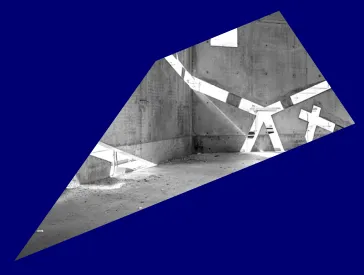
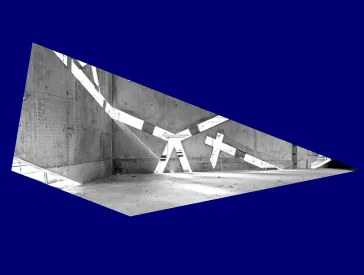
It Can’t Be That Nothing Can Be Returned
English Translation of the Transcript for the Video Installation by Dana Kavelina, 2022/2026
Scene 2. Greeting
Hello dear friend!
We-they are heartily glad to recognize your face. There are no words to describe this.
We know how painful and strange it can be to suddenly wake up alive again. We sympathize with you in the confusion you must be going through. That's why we put you in a semi-asleep state to show this movie.
We could not ask you in advance whether you want to come back to life again, because by asking each individual atom we would still not know the answer of the whole. We have disturbed the state of your matter scattered throughout the solar system and the earth. We had to borrow the atoms of your bodies from other existing objects of the world, in which they ended up - and many plants, stones and rivers agreed to return the matter of your body. Because we all loved and waited for you.
Now we can ask if you want to live again.
Of course, you can opt out. It’ll be completely painless. You will simply fall asleep again, and the atoms of your body will be distributed among the earth and the sky, and will be at peace with themselves, like the gray smile of a stone. You will still exist, but as clouds, as fog, as gray hair, without a central street, without your own memory.
It’s impossible for anyone to run out of space
It’s impossible that there is nowhere to go
It cannot be that you couldn’t return anything
You can leave at any other moment.
We are diverse beings living in a later time. That is, for you it is the future. We live in the same place where you lived – this place was then called Ukraine. There is no longer a system of state borders, so now we only use city names. We will tell you a little about the world in which we live in.
After the victory of Ukraine in the great war with Russia and the long work on the ruins, a lot has changed. Kyiv cyberneticians, who lived long before us, partially recreated Viktor Hlushkov's mind in order to jointly develop a model of artificial intelligence - OGAS-2. OGAS-2 automatically manages the economy and politics of communities, since then commodity-money relations have become obsolete and died, and this freed us from the need to work. All production was automated. Later, other artificial intelligences were created that allowed us to communicate with other forms of life – to monitor the sky and soil, to interpret the clouds and their will, to communicate with bacteria and other entities, to care for their health and common happiness.
We have many machines, some of them never hurt. They voluntarily perform all the monotonous work, such is their pleasure.
Some of them do not want to work – they grind the sky and are in an endless conversation with themselves.
All our time is free, and everyone can catch up with everyone. We try to cognize objects and move along their shape, or dance like ghosts, or talk to trees or houses. Worms once taught us not to die, and plants taught us to feed on sunlight. We have collectively devoted many decades to careful contemplation of the past. We carefully studied every day of the last two hundred years, and then built a master model of the past. This model contains the trajectory of each molecule at each moment in time – meaning we can see exactly what happened in the past. Roughly speaking, we now have all and any historical facts. When we restored the events of the war that began in Ukraine in 2022, many knew suffering, and the age of ghosts, the age of sorrow, began. We realized that we cannot move forward without simultaneously moving backward.
We realized that having all the facts is not enough to know the truth of the history. No, even the most complete picture of the past, is sufficient for this. The truth of history is to make history reversible. The truth of war calls for the resurrection of all the dead.
We found a way to bring back everyone who died in the 21st century on this earth.
You may be surprised by our appearance, but our essence is not alien to your essence.
We have slightly different bodies - we have learned to change them, bodies have become infinitely changeable. Some look like mushrooms or animals or water. We live together with animals that wanted to move to cities, plants learned to move.
We have developed many different organs that exist inside and outside the body.
But the only additional organ that almost all of us have is the organ of empathy, with which we can connect with another and speak their words, feel their feelings and communicate without words, through direct understanding of the other and regardless of their biological species, regardless of whether it is an organism or an object.
Our suits talk to us. We can communicate with our blood or sinews. Sometimes tendons want to live apart from the body. We respect their choice.
It is no longer necessary to be sick, we usually choose illnesses voluntarily in order to know or remember. We treat disease as historical knowledge.
Our cities resemble your cities. Only they hang above the ground. Earth is still dealing with the aftermath of the war and is still in the process of regenerating and finding balance, we trust it. We have found a way to interpret the thinking of the soil and consult with it on political issues.
The bodies of our cities are constantly moving, the streets are mobile. We live without a mayor, without a president, without an architect, without a doctor.
We built a city out of modules so that everyone can build their own house from the parts. Urban planning is a matter of contract and collective imagination. We move houses, streets and bridges whenever we want. So that everyone has enough light. We paint each other's faces on the houses.
Sometimes even trees migrate. Sometimes even the street wants to go outside and become an animal. Sometimes everything suddenly dances.
We understand that you may not want to be a part of this society. This is optional – you can come up with your own. But believe me, our cities are open to intervention, to the interweaving of your bodies, any political desires, memories and habits. And every voice will be heard, every memory will find a quiet place, and every wound will sing. There is infinite time for everyone.
We have infinite time for everyone.
We cordially invite you back to the life that rightfully belongs to all who have left. We have always been waiting for you.
There is no such thing as it’s impossible to help anyone
It cannot be that nothing can be returned.
Scene 6. Monument
At first it was difficult to get used to it. When it first appeared among us. We did not yet know how to deal with it, how to accept his omnipresence. It constantly flashed with holograms, voices. All these trenches, tanks, shimmering ruins. We understood its every word and every image as a call for something, as if it was constantly in need. Wanted to say or show something. We listened to it in alarm. We approached it to talk to it, but it suddenly disappeared. And sometimes, on the contrary, it could simply appear in someone’s bedroom, in the living room during dinner, bring its ruins, bark as dog or a cow.
We have not yet had the experience of dealing with memory as a living entity. History has always been like a database, the only consolation being the knowledge that nothing can be changed and voices from the past will not answer questions.
Something completely different appeared here.
Of course, we had a master model of the past – all facts, all words from a model consisting of the described movement of molecules in the past. Everything is convex. But digitized memories, called molds, are something completely different. There you can see someone's look, there are their feelings, fear. Like a movie shot through somebody else's eyes. The history takes on a magical dimension. Those who came back to life recorded their voices, they spoke to this monument, they gave molds of the past. All these molds, voices, all of this together suddenly became a living entity, gained freedom. Something similar to artificial intelligence, but different. This essence, of course, has no center, no personality. It is a multitude. Sometimes it's a chorus, sometimes noise, sometimes it doesn't hear itself. Sometimes it is in pain because, apparently, it’s arguing with itself and bifurcates.
Later we realized that it does not call for anything, does not show anything. It just tries to constantly remember itself, thinks of itself. It doesn't demand, it doesn't ask, it doesn't stop anywhere for a long time.
We learned to be together. Just to let it know that we are there and will always be.
‘apparently, the slumdogs, who had nothing anywhere …’
‘The cellars were opened up. doors were broken down. the apartment was opened. There were seven sweeps, snipers went through the basements, through the houses, I don’t know who they were looking for.’
‘we sat for three months, then we started to cough, because there was dampness and fungus everywhere.’
‘it's very difficult, I don't know how I'll survive it, but I'll survive it. God help me… please, God…’
Scene 7. Undoing history
Good day. Funes-1 artificial intelligence and a commission of mnemopsychologists conducted an analysis of the structure of your memory and approved the removal of memories that bother you. The commission's recommendation means that it will have a positive effect on your general well-being and will not affect the central vectors of your personality. Grievances from the past that keep coming back and causing pain will be gone forever. This happens according to your choice, meaning you can still change your mind. If you have any questions, I will be happy to answer them.
- I am very worried with the thought that if part of the memory is deleted, I will change, I won't be recognized, it won’t be me anymore.
-This is both true and not. We are not equal to our memory. Memory is not bigger than a person, or even its size. A huge part of you is made up of things you never think about - the desire of your nails to grow, the conversation of the cells of your feet and hands, the ability and inability to pity another. More often than not, we do not choose the pain that is inflicted on us. But we can choose not to subject our existence to it. We can take away obsessive memory's power over the time of life.
You will be different in some sense, of course, but it will only be a small shift in the direction of non-pain.
Even if you forget everything that ever happened to you, you won't be able to forget how to walk and breathe, your fingernails won't stop growing, and you won't stop understanding what others are saying in any language you know.
- And what to do with the missing fragment, after the procedure I will have a blackout?
-Yes and no. Before deleting a memory, you will describe it in words so that you can read the description after the procedure. That is, you will be able to learn about everything that happened to you, but you will not have the memory of the body. There will be no specific pain of recognition, no innumerable details that suddenly stick into the mind like needles, because of a random smell or a ray of sunlight in a poplar foliage. As if you hadn’t been experiencing it yourself, as if it was someone else. When you learn about what happened to you, all over again, it will be like looking at someone's photo, at the testimony of somebody else's pain.
In fact, if you want, you can even relive your own memory by ordering a screening of it in the master model of the past. Erasing this memory from your memory will not make it disappear forever. After all, you hand over a mold of the memories into the database of the Monument.
- And how will it continue to exist?
-Molds of memories make up the body of the Monument so that nothing is forgotten. So they also exist in the general model of the past, like everything that happened. You give the mold to the Monument so that memory remembers itself, it frees you from the burden of your individual past.
- Who will remember it, if not me?
-Memory itself will remember it. Becoming part of the Monument's body, the memory affects its behavior and desires, as if it were another organ or muscle, tendon or blood cell in the body. Your memory will merge with others, accept them, try to reconcile with itself.
Your memory will be available to others in the Master Model of the past. What happened to you, others will be able to remember. The nakedness of memory is now our common burden. But only by transferring the responsibility of memory to the register of collective labor, we are free from individual pain. Remembering is work. For some, this work is almost overwhelming, so it can be delegated to others. To equate a person's access to the ease of life, to individual happiness. We believe that one can choose one's own past, just as one can choose one's name or house or future.
- Still, why do you do it?
- Human history is a garden of bones. It is full of horrors and suffering. We believe that history can be stopped by eliminating individual liability for traumas. When no one is hurt by their past, sorrow will end, bones will be free, and the garden will bloom again. And how it will bloom! Not a garden of sorrow, but a garden of hope.
- Hope... I think I understand.
- Lie down. Breathe calmly. Try to remember in detail what you want to forget. From beginning to end. Now walk through your memory as if it were a long corridor. Now look to the left. Do you see the door? Get out through it and don't look back.
on screen appears:
We are our cells and their memory
We are our skin and its desires
We are the ground we walk on
We are our walk
We are our secret anger and tenderness
We are the desire of our nails to grow always
We are the songs that we obsessively sing in the morning and afternoon and in our sleep
We are our ability to empathize with others
We are our inability to empathize with others
We are the Other to ourselves
We are not what happened to us in the past
We can choose what happened to us in the past
We are potentially anything of anything
Scene 8. Question of punishment
We didn’t know how to coexist with them. How do you share the air with your killer? After all, they were resurrected with us then, and not everyone thinks that was right.
We were obsessed with revenge. To track, to find, to look in the eyes, to tear off the hands, as they say. We crowded around this model for days, watching. Each, of course, was obsessed with their own past. But it turns out, you find the culprit. You look at him. And then you face the emptiness of his face, the emptiness of his name. What does it mean that he has a name. What does it mean that he is somehow similar to us.
The complete emptiness of this knowledge. The emptiness inside revenge. There is nothing that is proportional to our pain. To punish them means simply adding their pain to ours, it’s, in a sense, an operation of addition, not subtraction. The pain of another will not cancel mine.
I spent many nights in a row imagining torture and execution. I was spinning a wheel in my head. What tortures could make us even, what would help me forgive. Nothing seemed sufficient. I talked to my dog, but she doesn't know much about it. Of course, she also remembers the explosion, the collapse, her death. But she seems to blame the rocket for exploding rather than whoever fired it. She doesn’t understand what I am telling her about revenge. Well, what can you do about her.
Then one of us said that revenge is a kind of fantasy about the equating of experience. That it will fix the inequality of suffering. And not just any suffering, but the inequality of our suffering. Since then, these Shared life -life sessions have been developed.
Of course, the locals here have no legal rights, no mechanisms of judicial power, and no concept of punishment. Because with them, any violence is reversible – a person can immediately be resurrected, a wound can instantly be healed, and the memory of it can be removed. But we wanted justice as we understood it. Well, they listened. And oh well, thanks for that.
We demanded that criminals be obliged to attend these sessions. That they dive into our memories and live them in virtual reality, in full immersion suits. So that they wouldn’t be able to forget it later. To see with our eyes, to be in our skin and all that. Of course, this is so that they reject themselves like gangrene, so that they want to become something else. That is, for a crack to appear. Maybe this will help us set ourselves free. Well, and they themselves. They probably also need to save themselves somehow.
Locals say that after that, they usually become historians.
Scene 9. Leaving the circle
A stone rolls down from the mountains
Sisyphus pushes it up
A stone rolls down from the mountains
Sisyphus pushes it up
A stone rolls down from the mountains
Sisyphus pushes it up
Sisyphus sings:
A stone flies up over the mountains
(Inger Christensen)

Exhibition The Opposite of Now: Artistic Paths to a Different Present: Features & Programs
Exhibition Webpage
- The Opposite of Now: Artistic Paths to a Different Present: 4 Sep 2026 to 10 Jan 2027
- Ephra trail for children and the adults accompanying them: Explore the exhibition through different stories!
- Choir of Time Astronauts: rehearsing in the exhibition: Thu 3 Sep, 10 a.m. + Tue 22 Sep, 4 p.m. + Fri 16 Oct, 10 a.m. + Thu 5 Nov, 4 p.m. + Wed 25 Nov, 4 p.m. + Fri 18 Dec 2026, 10 a.m. + Sun 10 Jan 2027
Accompanying Events & Tours
- Artist talks, film screenings, the JMB Book Club, panel discussions, and public tours: Find all dates in our calender
- Guided Tours for Groups: Tour by appointment
- Guided Tour for School Groups: Tour by appointment
Publications
Exhibition Catalog: English/German, Sep 2026
Digital Content
My Opposite of Now: Chat with M.O.O.N. about your opposite of now! The AI app from the exhibition available online
See also
- Fine Arts at the Jewish Museum Berlin
- 25 Years Jewish Museum Berlin: Discover our anniversary program, 2026