An Interview with Barbara Rösch about “Recommended Reading on National Socialism and the Holocaust”
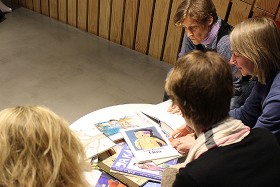
Members of the reading circle © Jewish Museum Berlin, photo: Christine Marth
A German-language brochure listing “Recommended Reading on National Socialism and the Holocaust” was recently made available for download from our website as a PDF. Over the last few years several museum employees read widely on the topic, shared their opinions and then made this selection. Dr. Barbara Rösch of our Education Department talked to me about what was involved. She is a member of the reading circle and also worked for a time at the Universities of Potsdam and Leipzig as an elementary school teacher trainer. In addition to her work at the Jewish Museum Berlin she is currently writing a book about everyday racism in elementary schools.
Dear Barbara, countless books about National Socialism and the Holocaust are available for children and young people. How did you go about making a selection?
Our work is oriented primarily to the needs of teachers, who regularly ask us to make recommendations and indeed seem almost to think that we must. We therefore bear in mind the so-called “classics” that are read in German classrooms as well as new publications, books written from a non-German perspective, and books that touch upon hitherto neglected themes, such as the hakhshara movement. → continue reading
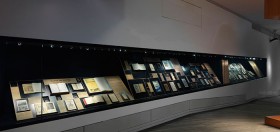
View of the cabinet exhibition “In a foreign country. Publications from the Displaced Persons Camps” in the basement of the Libeskind Building.
© Jewish Museum Berlin, photo: Jens Ziehe
In our cabinet exhibition “In a foreign country” we explore the publishing operations of survivors and refugees, the so-called displaced persons (DPs) who were stranded in occupied Germany after 1945. For this show we selected the widest variety of genres: schoolbooks, Judaica, volumes of poetry and prose, historical documentation, and Zionist pamphlets.
They all have two things in common: first, the quality of the paper these post-war printers used was extremely bad. Second, they all come from the Berlin State Library, whom we’re hosting for this exhibition due to its historically valuable collection of DP literature.
With one little exception. → continue reading
The “Daughters and Sons of Gastarbeiters” (guest workers) are the Academy of the Jewish Museum Berlin’s guest on 14 October 2015, part of the “New German Stories” series. As children, these Berlin authors followed their parents to Germany from their home villages in Anatolia, southern Europe and the Balkans, or they were born into working-class neighborhoods around Germany. Their mothers and fathers were supposed to bolster the German economic recovery as mere “guest workers”. The authors tell their personal stories, look back, follow their parents’ paths and thus add to Germany’s culture of memory. In advance of the event, we’ve asked three questions of Çiçek Bacık, the project’s leader and co-initiator:
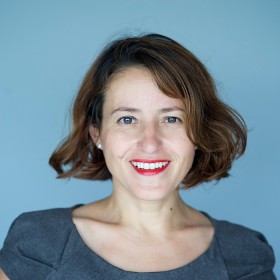
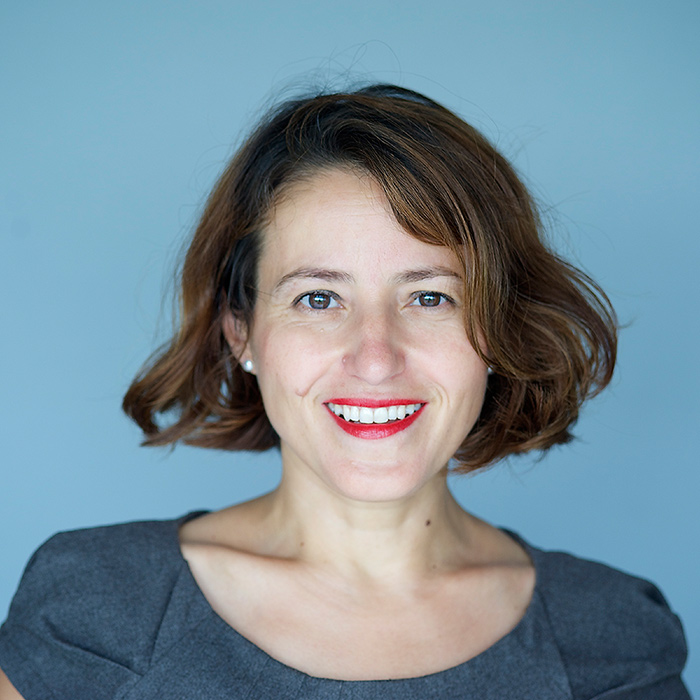
Çiçek Bacık © Neda Navaee
Ms. Bacık, how did the “Daughters and Sons of Gastarbeiters” come to be and what was the motivation to tell these personal stories?
Last year, I went to a reading with my friend, the journalist Ferda Ataman. We were sitting in a bar afterwards. “Ferda, we have to start telling our stories and share them with others. We ourselves have to shed light on a dark chapter of our past we’ve successfully repressed,” I said. “Sure, and what’s stopping us?” That was the starting point for “Daughters and Sons of Gastarbeiters”. Our first reading took place in January 2015 at the Wasserturm in Kreuzberg. → continue reading





 RSS feed
 Facebook
 Instagram
 Twitter: @jmberlin
 YouTube