
Posted by on  Comments
Season’s Greetings
Posted by on Comments
In Blessed Memory of Heinz-Joachim Aris
Obituary
It is with great sadness that we announce the death of our longstanding member of the Board of Trustees and friend Heinz-Joachim Aris, who passed away in the night to Friday 24 March 2017 at the age of 82.
Heinz-Joachim Aris served as deputy member to the Board of Trustees of the Jewish Museum Berlin from 2007. He supported the work of the Jewish Museum Berlin with great commitment and profound understanding. We mourn for our companion, as wise as he was prudent, whose heartfelt friendship we shall sorely miss. Our deepest sympathy goes to his wife, his family, and all those who were close to him.
Professor Peter Schäfer
Director, Jewish Museum Berlin Foundation
On behalf of all the staff
Posted by on Comments
Peddlers with Caftans, Sidelocks – and Umbrellas: Images of Jews around 1900
In Germany, you cannot rely on the weather being consistently sunny, even in the summertime. In the fall at the latest – dare we think of it already? – we will need to shake open our umbrellas again. Axel Stähler (comparative literature, University of Kent), has shown that the umbrella was once considered a Jewish attribute. He recently offered to share with Blogerim his research on the umbrella’s discursive significance in Wilhelminian Germany.
Dr. Stähler, how did you spot the “Jewish umbrella”?
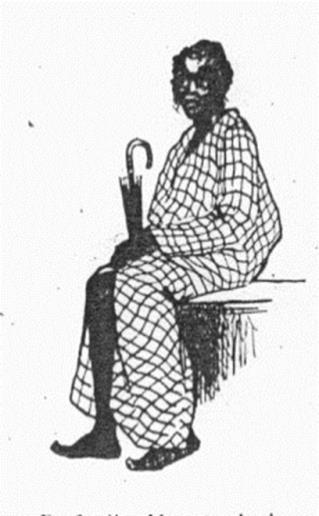
Mbwapwa Jumbo from “Briefe aus Neu-Neuland”, Schlemiel 1.1 (November 1903), p. 2
I was first struck by an umbrella in the hands of the “Big Chief of Uganda,” Mbwapwa Jumbo, a fictitious reporter in the Jewish satirical magazine Schlemiel, who acted as a correspondent from a new Jewish colony in Africa. In fact, in 1903, the British government had proposed to Theodor Herzl to commit land to Jewish settlers in the British Protectorate of East Africa. This proposal, which came to be known as the Uganda Plan, was vehemently disputed in the Zionist movement, and rejected in 1905. No concerted colonial Jewish settlement of Uganda ever took place, although individual Jewish immigrants had built homes there earlier.
In nine letters published over the course of the magazine’s brief lifespan, from 1903 to 1907, the chatty and naïvely amicable Mbwapwa tells of the first Jewish colonists – Orthodox Mizrachi – and of what became of them: in funny prose spotted with Anglicisms, and increasingly also Yiddishisms, he describes how he and his countrymen converted to Judaism. He relates the murder of a reformist rabbi who had been smuggled into the country, and the reformers’ ensuing punitive military expedition. He reports on the colony’s political and cultural trials and tribulations, and, finally, on the emergence of the Zionist movement—since Uganda was not, after all, the Promised Land. → continue reading

 RSS feed
 Facebook
 Instagram
 Twitter: @jmberlin
 YouTube