Claude Lanzmann:
The Recordings
Exhibition
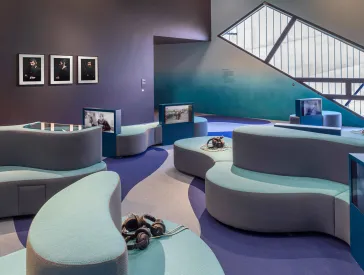
To mark the centenary of the birth of Claude Lanzmann (1925–2018) – the acclaimed French journalist, filmmaker and chronicler of the Shoah – the Jewish Museum Berlin presents an exhibition that makes history audible. For the first time ever, the audio archive of Lanzmann’s world-renowned documentary film Shoah (1985) will be made accessible to the public.
The Lanzmann Collection offers profound insight into Lanzmann’s working methods and the development of his epoch-making work. These unique audio recordings are the heart of the exhibition, which can be explored through sound, and are complemented by objects, documents, and film footage.
Past exhibition
Where
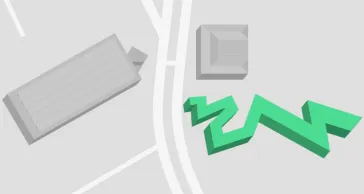
Libeskind Building, ground level, Eric F. Ross Gallery
Lindenstraße 9–14, 10969 Berlin
Introduction
Forty years before the opening of this exhibition, Shoah premiered in Paris in 1985. The French director, Claude Lanzmann, had spent twelve years working on the project. To this day, the film – more than nine hours long – remains groundbreaking in its presentation of the Nazi genocide of six million Jews. For Shoah, Lanzmann interviewed survivors, perpetrators, and eyewitnesses, and went searching for traces at the sites of systematic extermination. He decided not to use any archival images at all.
The exhibition presents the years of preparation for shooting the film. During that time, Claude Lanzmann and his team, Corinna Coulmas and Irena Steinfeldt-Levy, researched in various countries and conducted countless preliminary conversations, which were recorded on cassette tapes. These previously unknown audio recordings reveal that the director considered many different aspects of the Shoah before settling on the extermination as his main theme. At the same time, they offer insights into individual memory three decades after the end of the war.
The Lanzmann Collection at the Jewish Museum Berlin consists of roughly 220 hours of audio recordings in eight languages. These holdings, together with the film Shoah, were added to the UNESCO Memory of the World register of documentary heritage in 2023.
The Research
“It is an inquiry about the Holocaust.”
(Claude Lanzmann)
In these recordings, Claude Lanzmann explains his film project and responds to the questions of his interlocutors. They ask about his methods and perspectives, as well as psychological challenges, biographical motivation, and financial and organizational conditions.
Corinna Coulmas and Irena Steinfeldt-Levy were involved in the project from almost the very beginning. They translated from German and Hebrew, researched individuals and themes, and carried out preliminary conversations. In an interview, they recollect their ten-year collaboration with Claude Lanzmann.
Media Related to the Exhibition Topic The Research
-
Clips form several conversations
Erich Kulka, Pauline and Jacob Werbin, Maria Bobrow, Ilana SafranYou can access transcriptions by clicking the “Read along” link below each video. Depending on your screen size, you may also be able to view an enlarged version of the videos there.
-
Interview with Corinna Coulmas and Irena Steinfeldt-Levy, conducted by exhibition curator Tamar Lewinsky, with German and English subtitles; Jewish Museum Berlin, 2025
Unheard Voices
“You can be perfectly silent in front of the camera.”
(Claude Lanzmann)
Not everyone who was interviewed was willing to speak in front of a camera. Three recordings presented in the exhibition feature people whom Claude Lanzmann could not convince to participate in the filming.
Ilana Safran talks about her deportation from the Netherlands to Sobibor, her arrival at the extermination camp, and the prisoner uprising. She also recounts how she was asked to identify perpetrators as a witness in the Sobibor trial in the mid-1960s.
The building contractor Hermann Gräbe describes how he witnessed mass murders in German-occupied Ukraine and protected hundreds of forced laborers from the Nazis. He was helped by Maria Bobrow, herself a forced worker in his company.
Media Related to the Exhibition Topic Unheard Voices
-
Part I
Ilana SafranYou can access transcriptions, and, where applicable, translations of the audio texts by clicking the “Read along” link below each video. Depending on your screen size, you may also be able to view an enlarged version of the videos there.
-
Part II
Maria Bobrow/Hermann Gräbe
The Shoah in Lithuania
“.לדבר על הגטו אני לא יכול”
“I cannot talk about the ghetto.”
(Avrom Sutzkever)
At the very beginning of his preparations, Claude Lanzmann intensively researched the murder of Lithuanian Jews.
The tape recordings chronicle the murderous events that started in the summer of 1941 during the German occupation. Eyewitnesses talk about pogroms carried out by the local population. They mention the massacres by the SS mobile killing squads (Einsatzgruppen) in the Ninth Fort in Kaunas and the Ponary Forest near Vilnius. These squads murdered three-quarters of the Jewish population in the first six months.
In the conversations, the survivors struggle to find words for their life in the ghettos of Kovno (Kaunas), Shavli (Šiauliai), and Vilna (Vilnius). The subject is virtually absent from the finished film.
Media Related to the Exhibition Topic The Shoah in Lithuania
The Perpetrators
„Nee, das ist erledigt für mich!“
“No, that’s over for me!” (Richard Otto Horn)
Claude Lanzmann decided early on that he also wanted to interview perpetrators for his film. He searched for high-ranking functionaries in Germany and those who implemented the mass murder, along with bureaucrats, profiteers, and the witnesses from the postwar trials.
The director and his team called on the perpetrators at home, unannounced. In many cases, the conversation ended at the front door. If the team was allowed inside, the tape recorder remained out of sight. The perpetrators, if they were willing to speak at all, became tangled up in their justifications, self-serving claims, deflections of guilt, and attempts to exonerate themselves.
Media Related to the Exhibition Topic The Perpetrators
-
Part I: Refusal and Repression
Ulrich Brand, Otto Horn, Lothar FendlerYou can access transcriptions, and, where applicable, translations of the audio texts by clicking the “Read along” link below each video. Depending on your screen size, you may also be able to view an enlarged version of the videos there.
-
Part II: Conversation Strategies
Edmund Veesenmayer -
Part III: Ignorance and Denial of Guilt
Kurt Eisfeld, Karl Wolff
First Trip to Poland
« C’était une marche macabre. »
“It was a march of the dead.”
(Andrzej Modrzewski)
Claude Lanzmann’s first trip to Poland was crucial for his examination of the murder of European Jewry. He had delayed the journey until the rest of his research was complete.
In early 1978, when he traveled to the sites of persecution and extermination, his head was already filled with knowledge from books, files, and countless conversations – but the vivid presence of the history he confronted in Poland struck him with unexpected force. The audio recordings made during the trip document not only the conversations with eyewitnesses, but also Lanzmann’s impressions upon visiting the sites.
Later that same year, Claude Lanzmann returned to Poland and started filming Shoah.
Media Related to the Exhibition Topic First Trip to Poland
-
Part I: Sites of Persecution and Extermination
Szymon Datner, Władysław Janicki, Berek Rojzman, Andrzej Modrzewski, Jan PiwońskiYou can access transcriptions, and, where applicable, translations of the audio texts by clicking the “Read along” link below each video. Depending on your screen size, you may also be able to view an enlarged version of the videos there.
-
Part II: Auschwitz
Claude Lanzmann
Please Note
Over the coming weeks, we will continue to publish the audio recordings featured in the exhibition on this webpage.
Audio and Film
„To się nie da bezboleśnie zrobić.“
“This can’t be done without pain.”
(Jan Piwoński)
Very few people can be heard both in the audio recordings and in Shoah or its extensive raw footage. One of them is Jan Piwoński. The interview sequences with Piwoński at the Sobibór train station play an important role in Shoah; Leon Kantarowski appears briefly in a scene in front of the church in Chełmno, where he was an organist. However, the footage with Tadeusz Pankiewicz, the non-Jewish pharmacist in the Krakow ghetto, was not used in Shoah. Also, the interview with Hillel Kook, in which he accuses the American government of having done nothing to save European Jews, can be seen only in the raw footage, not in the completed film.
Interviewees
Short biographies of the interviewees featured in the exhibition:
- Yitzhak Arad (1926–2021)
- Maria Bobrow (1909–2000)
- Ulrich Brand (1909–?)
- Szymon Datner (1902–1989)
- Kurt Eisfeld (1904–?)
- Lothar Fendler (1913–1988)
- Anushka Freiman (1918–1999)
- Shlomo Gol (1907–1986)
- Sara Gol (1914–2003)
- Hermann Friedrich Gräbe (1900–1986)
- Otto Horn (1903–1999)
- Władysław Janicki (1903–1984)
- Leon Kantarowski (dates unknown)
- Hillel Kook (1915–2001)
- Erich Kulka (1911–1995)
- Andrzej Modrzewski (1903–1993)
- Tadeusz Pankiewicz (1908–1993)
- Dr. Wulf Pessachowitz (probably 1907–2000)
- Jan Piwoński (1924–1989)
- Berek Rojzman (1912–1995)
- Ilana Safran (1926–1985)
- Avrom Sutzkever (1913–2010)
- Edmund Veesenmayer (1904–1977)
- Jacob Werbin (1918–1994)
- Pauline Werbin (1917–2010)
- Karl Wolff (1900–1984)
Yitzhak Arad (1926–2021)
Yitzhak Arad was born Isaak Rudnicki in Święciany (now Švenčionys, Lithuania). He was a member of the Zionist youth movement HaNoar HaTzioni and attended a Jewish high school in Warsaw. After the German invasion of Poland in 1939, he fled Warsaw with his sister, returning to his hometown, where he witnessed the establishment of the ghetto in the summer of 1941. He became active in the underground movement and escaped the ghetto in February 1943, fighting with Soviet partisans in Belarus until the end of the war. In 1945, he immigrated illegally to British Mandate Palestine, where he joined the Palmach and fought in the Israeli War of Independence. He rose to the rank of brigadier general in the Israeli army and later taught Jewish history at Tel Aviv University. Arad served as director of Yad Vashem from 1972 to 1993. He maintained close ties to Yad Vashem throughout his life and wrote numerous works on the Holocaust in the Soviet Union and on the extermination camps established under Operation Reinhardt. He died in Tel Aviv at the age of ninety-four.
To the list of all interviewees
Maria Bobrow (1909–2000)
Maria Rozalia Bobrow-Levy was born Rozalia (“Rosa”) Kavenocki (Kaven) in Łódź, Poland. After studying education in Warsaw, she worked as a teacher. Following the German invasion of Poland, she and her husband fled to Zdołbunów (today Zdolbuniv, Ukraine) in the Soviet-occupied eastern part of the country. When German forces advanced into the region in the summer of 1941, her husband was fatally shot by members of the killing squad Einsatzgruppe C. In the autumn of 1941, she was conscripted for forced labor at the Josef Jung construction company, directed by Hermann Friedrich Gräbe. Together with Gräbe and others, she helped save several hundred Jews from deportation. She disguised herself as a Catholic Pole, using the name Maria Warchiwker. In January 1944, she fled with Gräbe and around one hundred forced laborers to western Germany and later to Belgium and France. After the war, she worked in Wiesbaden and Augsburg documenting the Nuremberg trials. She immigrated to the United States in April 1947, initially settling in New York and working in a hospital. In 1953, she married Jack Bobrow, with whom she moved to Florida in 1964. After his death in 1984, she married Victor Levy. She died at her home in Surfside, Florida, in 2000.
To the list of all interviewees
Ulrich Brand (1909–?)
Ulrich Brand was born in the Wilmersdorf district of Berlin. A lawyer by training, he joined the Nazi Party in 1933 and served in the SA from 1933 to 1939. In 1938, he began working for the Deutsche Reichsbahn, the German state railway. Between 1943 and 1945, he was a personnel officer at the Reichsbahn’s regional office in Oppeln, which was responsible for transports to the Auschwitz extermination camp. In the 1970s, he testified at the trial of Albert Ganzenmüller, former state secretary in the Reich Ministry of Transportation.
To the list of all interviewees
Szymon Datner (1902–1989)
Szymon Datner was born in Krakow, where he studied law and history and earned a doctorate in anthropology in 1927. Between 1922 and 1929, he taught at Jewish schools in Krakow, Kielce, Pinsk, and finally in Białystok, where he settled. In 1941, he was forced into the Białystok ghetto with his family. He joined the underground movement and, after escaping from the ghetto, fought in various partisan units. His wife and two daughters perished in the ghetto. From 1944 to 1946, he chaired the Committee of Polish Jews in Białystok and conducted research on the Holocaust. He worked for the Jewish Historical Institute (ŻIH) in Warsaw from 1948 to 1953, then for the Main Commission for the Investigation of Nazi Crimes in Poland from 1956 to 1968. He was forced to resign from all his posts during the political crisis of 1968, but was later reinstated. From 1969 to 1970, he served as director of the ŻIH. He died in Warsaw in 1989.
To the list of all interviewees
Kurt Eisfeld (1904–?)
Kurt Eisfeld was born and educated in Gröningen. After completing high school in Halberstadt, he studied chemistry at Jena, where he earned his doctorate. In 1929, he joined I.G. Farben, working as a research chemist at the Hoechst plant until 1935, when he was transferred to the company’s headquarters in Frankfurt am Main. From 1938 to 1941, he was plant manager for I.G. Farben in Ludwigshafen. As an authorized company representative responsible for project planning, he made several trips to Poland to find a suitable site for a new industrial complex – Buna-Monowitz (Auschwitz III). His last position at the labor camp was that of technical director of a production unit. Eisfeld joined the Nazi Party in 1933 and was a member of the SS from 1933 to 1938. After the war, he worked as an agricultural laborer. He testified at the I.G. Farben trials but was never charged himself.
To the list of all interviewees
Lothar Fendler (1913–1988)
Lothar Fendler was born in Breslau (Wrocław, Poland). He studied dentistry from 1932 to 1934, joined the SS in 1933, and served in the Wehrmacht from 1934 to 1936. In 1936, he entered the Security Service of the Reichsführer SS, with postings in Breslau, Olomouc, and Berlin. He joined the Nazi Party the following year and by 1940 had risen to the rank of an SS-Hauptsturmführer (captain). From June to early October 1941, during the German invasion of the Soviet Union, he served as deputy commander of Sonderkommando 4b, a subunit of the killing squad Einsatzgruppe C. He was also the liaison officer between an operational squad and the Wehrmacht. After the war, he worked on a farm in Bavaria until his arrest in November 1945. In 1948, he was sentenced to ten years’ imprisonment in the Ninth Subsequent Nuremberg Trial, which dealt with the crimes of the mobile killing squads. He was released early in 1951 and died in Stuttgart.
To the list of all interviewees
Anushka Freiman (1918–1999)
Anushka Freiman, née Anja Schmidt, was born in Ponevezh (now Panevėžys, Lithuania). She studied and worked in Kovno (Kaunas), marrying the cellist Misha Shenkor in 1940. In 1941, she was forced into the Kovno ghetto, where her daughter was born in November 1942. In October 1943, she was separated from her husband and daughter and deported to the Vaivara–Klooga concentration camp complex in Estonia. From there, she was transferred to Stutthof and finally to the Ochsenzoll ammunition factory near Hamburg. Her daughter was murdered in Auschwitz; her husband was liberated from a Stutthof subcamp but died of typhus in 1945. After the war, she worked as a translator in the Bergen-Belsen displaced persons camp and as a secretary for the British Pioneer and Civil Labour Unit in Gifhorn. She later moved to Johannesburg to join her brothers and became active in the South African Jewish Board of Deputies. Around 1966, she immigrated with her second husband and children to Israel, where she volunteered at Yad Vashem and helped organize the first World Gathering of Holocaust Survivors in Jerusalem in 1981.
To the list of all interviewees
Shlomo Gol (1907–1986)
Shlomo (Szloma) Gol was born in Kovno (now Kaunas, Lithuania) and studied at a yeshiva in Vilna (Vilnius). In the summer of 1941, he was confined to the ghetto there. In December 1943, he was deported to Ponary, where he was forced to exhume and burn the corpses of massacre victims from a mass grave. He secretly dug a tunnel with fellow prisoners and used it to escape on 15 April 1944, later writing an account of his experiences. Gol joined the Jewish partisans under the command of Abba Kovner and, in 1944, married Sara Shtok (née Joffe). In 1946, he testified at the Nuremberg Trial of Major War Criminals. From 1946 to 1949, he lived with his wife in the Feldafing displaced persons camp, where their son Abraham was born. The family immigrated to Israel in 1949 and moved to Jacksonville, United States, in 1962.
To the list of all interviewees
Sara Gol (1914–2003)
Sara Gol was born in Vilna (now Vilnius, Lithuania) to Abraham and Minuche Joffe. Before the war, she lived in Vilna with her first husband and their four children. Her first son was killed in an air raid as an infant, her second son died a few months after birth, and her husband succumbed to tuberculosis. In 1944, she was liberated with her daughter Rachel; her other daughter did not survive the ghetto. That same year, she married Shlomo Gol. After stays in Łódź, Berlin, and Munich, she arrived at the Feldafing displaced persons camp with him and her daughter. In the camp, she gave birth to her son Abraham and trained as a seamstress. In 1949, the family immigrated to Israel and settled near Tel Aviv. In 1962, they moved to Jacksonville, United States.
To the list of all interviewees
Hermann Friedrich Gräbe (1900–1986)
Hermann Friedrich Gräbe was born in Gräfrath near Solingen. He and his wife, Elisabeth Stader, had one son, Friedel. From 1931 to 1934, Gräbe was a member of the Nazi Party, and in 1938 he began working as an engineer for the Josef Jung construction company. In October 1941, he established a branch of the company in Zdołbunów (now Zdolbuniv, Ukraine) for its client, the Reich Railway Administration. In November 1941, July 1942, and October 1942, Gräbe witnessed massacres carried out by SS mobile killing squads in Rovno and Dubno. In response, he deliberately hired Jewish workers to protect them from persecution. Supported by Maria Bobrow, he gradually set up fictitious company branches in Volhynia and Poltava to save additional lives. In January 1944, he evacuated around one hundred forced laborers from Zdołbunów, passing through Warsaw on the way to the Eifel region. After the war, Gräbe was a witness for the prosecution at the Nuremberg trials. Facing widespread hostility in West Germany, he and his family immigrated to California. In 1954, he obtained U.S. citizenship and adopted the name Herman Frederick Graebe. In the 1960s, he was prosecuted for perjury and targeted by defamatory articles in Der Spiegel. In 1965, Yad Vashem honored him as one of the Righteous Among the Nations. He died in San Francisco.
To the list of all interviewees
Otto Horn (1903–1999)
Richard Otto Horn was born in Obergrauschwitz, Saxony. After training as a nurse, he worked at the psychiatric hospital in Arnsdorf. He joined the Nazi Party in 1937 and served as a Wehrmacht medic in Poland and France in 1939. In the summer of 1941, he was discharged from military service and transferred to the Sonnenstein killing center, where he took part in Aktion T4, the Nazi “euthanasia” program. Beginning in October 1942, he served as an SS corporal in the Treblinka extermination camp, where he supervised the digging detachment. After the uprising in the camp in September 1943, he returned to Arnsdorf. Later, he was briefly assigned to the unit Einsatz R in Trieste, which was responsible for the deportation and murder of Jews. After the war, Horn was taken prisoner by Soviet forces. From 1946 on, he worked as a nurse in Berlin. In 1965, he was acquitted in the first Treblinka trial. In 1987, Horn testified at the Demjanjuk trial.
To the list of all interviewees
Władysław Janicki (1903–1984)
Władysław Janicki was born in Warsaw, the son of a railway engineer. He studied law at the University of Warsaw and from 1931 to 1932 served as a judge at the district court in Siedlce. In 1932, he began working in Siedlce as a lawyer. During the German occupation, Janicki was involved in the Polish underground. He was arrested in 1941 and sentenced to death with several others, but was released after payment of a fine imposed on the city of Siedlce. In 1942, he witnessed the liquidation of the Siedlce ghetto, and after the war he helped investigate Nazi crimes in Poland. His daughter, Barbara Janicka, appears in Shoah as a translator. He died in Warsaw.
To the list of all interviewees
Leon Kantarowski (dates unknown)
Leon Kantarowski was an organist at the church in Chełmno. During the Second World War, he worked in forestry.
To the list of all interviewees
Hillel Kook (1915–2001)
Hillel Kook was born in Kriukai (now in Lithuania), the son of Rabbi Dov Kook. His uncle Isaac Kook was the first Ashkenazi chief rabbi of British Mandate Palestine. In 1925, Hillel Kook immigrated to Jerusalem with his family. In the 1930s, he became active in paramilitary Zionist organizations and joined the Irgun movement, led by the revisionist Zionist Vladimir Ze’ev Jabotinsky. In 1937, the Irgun sent him to Poland to help organize Jewish immigration to Palestine. In 1940, he accompanied Jabotinsky to the United States, where he adopted the pseudonym Peter Bergson. The following year, he helped establish the Committee for a Jewish Army of Stateless and Palestinian Jews. In 1942, he founded the Emergency Committee to Save the Jewish People of Europe, which was involved in setting up the American War Refugee Board in January 1944. He reverted to his original name, Kook, in 1948 and returned to Israel. From 1949 to 1951, he served as a member of the first Knesset, and then moved back to the United States, where he lived until 1968. He died in Kfar Shmaryahu, Israel.
To the list of all interviewees
Erich Kulka (1911–1995)
Erich Kulka was born Erich Schön in Vsetín, Moravia, to Malvina and Siegbert Schön. In July 1939, he was arrested by the Gestapo for resistance activities and imprisoned in Brünn (now Brno, Czech Republic). He was then deported to the concentration camps of Dachau, Sachsenhausen, and Neuengamme – and finally, in November 1942, to Auschwitz-Birkenau. During the “evacuation” of the camp by the SS in January 1945, he escaped with his twelve-year-old son. After the war, he adopted the family name of his first wife, Elly Kulka, who had died in Stutthof in 1945. In 1946, with Ota Kraus, he co-authored the first historical account of the Auschwitz-Birkenau extermination camp. As an author, journalist, and historian, he wrote extensively about the Shoah, particularly about the persecution of Czechoslovak Jews. He testified at the war crimes trials in Poland in 1946–47 and at the Auschwitz trials in Frankfurt in the 1960s. In 1968, he emigrated from Czechoslovakia to Israel. He died in Jerusalem in 1995.
To the list of all interviewees
Andrzej Modrzewski (1903–1993)
Andrzej Modrzewski was born in Lublin, Poland. In 1920, he volunteered to fight in the Polish–Soviet War. He studied law in Lublin, where he co-founded the Concordia fraternity and held several leadership positions. After earning his first degree, he continued his studies in Nancy and at the Sorbonne in Paris from 1926 to 1927. He then worked for several years as an assistant instructor at the Department of Civil Law at the Catholic University of Lublin before establishing himself as a lawyer. He helped defend Poland against Germany and, after his arrest in November 1939, was imprisoned for several weeks in Lublin Castle. After 1945, he resumed practicing law in Lublin.
To the list of all interviewees
Tadeusz Pankiewicz (1908–1993)
Tadeusz Pankiewicz was born in Sambor (now Sambir, Ukraine), the son of a pharmacist. He graduated from high school in Podgórze in 1927 and earned a degree in pharmacy in Krakow in 1930. After his studies, he worked in his father’s pharmacy, Pod Orłem, on Plac Zgody (now Plac Bohaterów Getta), which he took over in 1934. Between 1941 and 1943, he was the only non-Jew permitted to live and work in the Krakow ghetto. He helped the ghetto’s residents in numerous ways, and his pharmacy became a hub of underground activity. During the deportations, he supplied people with medicine and food and hid those in danger in his pharmacy. In 1942, he was threatened with deportation himself. After 1945, he managed several pharmacies in Krakow. From 1951 onward, he testified in trials of Nazi perpetrators in Poland and Germany. In 1983, he was recognized as one of the Righteous Among the Nations. His first pharmacy, in the Krakow ghetto, now houses a museum.
To the list of all interviewees
Dr. Wulf Pessachowitz (probably 1907–2000)
Dr. Wulf Pessachowitz was born in Šiauliai (Shavli), Lithuania. He completed his medical studies in Prague in 1930 and returned to Šiauliai in 1937. After the German invasion of Lithuania in the summer of 1941, he was confined to the city’s ghetto, where he served as director of the hospital. When the Nazis banned births in the ghetto in August 1942, he was forced to perform abortions. In 1944, he was deported to the Stutthof concentration camp and later to Dachau. After liberation, he settled in Munich, where he worked at the UNRRA hospital for victims of Nazi persecution. He later immigrated to the United States and worked as a physician at Mount Sinai Hospital in New York, changing his name to William Pace. He died in New York.
To the list of all interviewees
Jan Piwoński (1924–1989)
Jan Piwoński was born in Żłobek, a village near Sobibór. During the spring of 1942, he carried out maintenance work on railroad tracks, and from July onward, he was employed as an assistant switchman at the Sobibór station in German-occupied Poland. Beginning in 1944, he served in the Polish armed forces. After the war, he studied history and wrote his thesis on the Sobibor extermination camp. He was interviewed during a reconstruction of the Sobibor crimes and testified at the trials held in the 1960s and 1970s in Wrocław, Włodawa, Lublin, and Warsaw. He lived in Okuninka near Włodawa until his death.
To the list of all interviewees
Berek Rojzman (1912–1995)
Berek Rojzman was born in Nadarzyn near Warsaw. In July 1942, during the deportations from the Warsaw ghetto, he fled to Biała Rawska, from where he was deported to the Treblinka extermination camp. He escaped death in the gas chambers when an acquaintance hid him in a pile of clothes. At Treblinka, he was assigned to a sorting detail. As a member of the underground movement, he escaped during the camp uprising in 1943 and lived in hiding in the forests near Otwock until liberation. After the war, he remained in Poland, marrying and settling in Międzylesie near Warsaw.
To the list of all interviewees
Ilana Safran (1926–1985)
Ilana Safran was born Ursula Stern in Essen, to Albert Stern and Anna Rosa Schönenberg. In 1933, her family moved to Epe in the Netherlands. With the German occupation in 1940, she went into hiding. In January 1943, she was arrested and later deported to the Westerbork transit camp after being held in the Wolvenplein prison in Utrecht and the Herzogenbusch concentration camp in Vught. On 6 April 1943, she was transferred to the Sobibor extermination camp in occupied Poland, where she performed forced labor in the sorting sheds, in the forest detachment, and in the ammunition depot. During the prisoner uprising on 14 October 1943, she fled into the surrounding forests and later joined the partisans. After the war, she returned to the Netherlands and eventually immigrated to Israel. She and her husband, Zwi Safran (born Horst Martin Buchheimer), had two children. In 1965, she testified at the Sobibor trial, held in the regional court in Hagen. She died in Ashkelon, Israel.
To the list of all interviewees
Avrom Sutzkever (1913–2010)
Avrom (Abraham) Sutzkever was a Yiddish writer and poet born in Smorgon (now Smarhon, Belarus). During the First World War, he and his family lived in the Siberian city of Omsk, but in 1921 they moved to Vilna (Vilnius). He joined the “Yung-Vilne” writers’ group in 1933, and his first poetry collections were published in Warsaw and Vilnius. In 1939, he married Freydke Levna. Imprisoned in the Vilna ghetto, he joined the resistance and continued to write, escaping to the partisans in September 1943. The Jewish Anti-Fascist Committee brought him and his wife to Moscow, where he contributed to Ilya Ehrenburg’s Black Book. After the war, he testified at the Nuremberg trials. In 1946, following the birth of their daughter Rina, the family moved to Poland, then to France, and finally, in 1947, to Palestine. Sutzkever founded and edited the literary journal Di goldene keyt (1949–1995) and published numerous other works. He died in Tel Aviv, Israel.
To the list of all interviewees
Edmund Veesenmayer (1904–1977)
Edmund Veesenmayer was a German diplomat and high-ranking SS officer. Born in Bad Kissingen, he studied in Munich and later lectured in economics. He joined the Nazi Party in 1932 and the SS two years later. As a political operative, he played a key role in the annexation of Austria in 1938 and the dismemberment of Czechoslovakia in 1939. During his time at the German Foreign Office, he was posted to Zagreb shortly before the German invasion and was instrumental in the persecution of Croatian and Serbian Jews. From March 1944, he served as the German envoy and plenipotentiary in Hungary, where he took part in the deportation of Hungarian Jews to Auschwitz. In 1949, he was sentenced to twenty years’ imprisonment for crimes against humanity at the Wilhelmstrasse Trial in Nuremberg. After his early release in 1951, he worked as a sales representative in Iran from 1952 to 1955 before settling in Darmstadt.
To the list of all interviewees
Jacob Werbin (1918–1994)
Jacob (Yankel) Werbin was born Jacob Werbovski in Okmyany (now Akmenė, Lithuania) to Nachum Mordechai Werbovski and Yente Kahn. He married Pauline (Pese) Werbin, née Yankelewitz. He was assigned to guard the gate of the Kovno (Kaunas) ghetto, established in the summer of 1941, and on 8 July 1944 escaped with his wife during the ghetto’s liquidation. After the war, he was arrested by the Soviets in Lithuania but released the following year. In November 1949, he immigrated with his wife to the United States and in 1951 settled in California. He died in New York.
To the list of all interviewees
Pauline Werbin (1917–2010)
Pauline (Pese) Werbin was born in Šeta, Lithuania, to Chaim Yankelewitz and Fruma Meltzer. She married Jacob (Yankel) Werbin. In July 1941, she was deported to the Kovno (Kaunas) ghetto, but on 8 July 1944, she managed to escape with her husband during the ghetto’s liquidation. In November 1949, the couple immigrated to the United States and in 1951 settled in California. She died in New York.
To the list of all interviewees
Karl Wolff (1900–1984)
Karl Wolff was born in Darmstadt, the son of a district court judge. After completing a shortened high school education in 1917, he volunteered for military service. He trained as a banker in Frankfurt am Main and later founded an advertising agency in Munich. In 1931, he joined the Nazi Party and the SS. In 1933, he entered the Reichstag as a Nazi deputy, and in 1934 he was appointed chief adjutant to Heinrich Himmler. From 1936 onward, he served as Chief of the Personal Staff of the Reichsführer SS. At the outbreak of war, he was the SS liaison officer at Hitler’s headquarters. In 1943, as SS-Obergruppenführer and General of the Waffen-SS, Wolff was the highest-ranking SS and police officer in Italy, with responsibilities including so-called anti-partisan operations. In 1945, he took part in the secret negotiations with the Western Allies over a ceasefire in Italy. He was interned after the war and appeared as a witness at the Nuremberg trials. In 1949, he received a four-year prison sentence that was counted as fully served. Wolff was arrested again in 1962 and, two years later, found guilty as an accessory to murder and sentenced to fifteen years. He was released early in 1969 for health reasons and died in Rosenheim.
Insights and Future Access
The audio recordings represent only part of the many years of preparation for the film Shoah. Not all the conversations were recorded. Claude Lanzmann’s private archive includes letters, lists, notes, and index file cards from this period of research that offer further insights into the practical work of the director and his team.
To enable an in-depth exploration of the Lanzmann Collection, the interviews from the exhibition will be available on the online platform Oral-History.Digital (OH.D) with full transcription, translation, and contextualization. This digital edition will be continuously expanded and will be accessible in its entirety by late 2027. Registration is required to access OH.D.
Screenshot of the user interface of the Lanzmann Collection on the online platform Oral-History.Digital (OH.D)
Editorial Note
The audio recordings in the Lanzmann Collection were not created for the purpose of publication. Rather, these were working materials produced during the development stage of the film Shoah.
Today, the recordings and the film together constitute an entry in UNESCO’s Memory of the World Register “for the preservation of the documentary heritage of humanity
.” This designation entails the responsibility to enable, safeguard, and preserve free access to these significant audio recordings, and to draw attention to the extraordinary importance of the collection. In doing so, it was essential for us to find a sensitive approach to the personality rights of the individuals whose voices are heard in the interview recordings. A central component of this effort is the systematic clarification of rights for all recordings in the Lanzmann Collection.
In addition to the legal claims that must be clarified, ethical considerations also arise in cases where the recordings include voices of individuals who did not wish to appear in the film. Their wish not to be shown may reasonably be understood to extend to any future form of public dissemination. The Online Edition, which provides access to the complete audio recordings, is therefore governed by the terms of use of a digital audio archive. Each user must agree to abide by these terms in advance.
The Online Edition of the Lanzmann Collection is a research and cataloguing project currently in development. Beginning in November 2025, its results will be released for further use in stages on the online platform Oral-History.Digital (OH.D). If you can provide helpful information regarding unidentified individuals or content, please contact us at avmedien@jmberlin.de.
Thank you.
Visual Impressions from the Exhibition
Exhibition content in German Sign Language (DGS), with English and German Subtitles
The Lanzmann Collection
Collections and Projects
The Audio Archive in the Collection of the Jewish Museum Berlin: Projects to catalog, preserve, and share its legacy
Exhibition Webpage
Current page: Claude Lanzmann: The Recordings: 28 Nov 2025 to 12 Apr 2026
Conference
The Sound of History. Claude Lanzmann’s Preparation for Shoah: Conference from 9 to 10 Feb 2026
Digital Content
- Claude Lanzmann, filmmaker and journalist
- Shoah (1985) by Claude Lanzmann
- The Lanzmann Collection on the Oral-History.Digital (OH.D) online platform: All audio recordings from the Lanzmann Collection will be available on OH.D by the end of 2027 (registration required)
- JMB di.kla: Online offering on the topic of the Shoah for grades 11 and above
Exhibition Information at a Glance
- When 28 Nov 2025 to 12 Apr 2026
- Entry Fee Free of charge
- WhereLibeskind Building, ground level, Eric F. Ross Gallery
Lindenstraße 9–14, 10969 Berlin
See Location on Map
Credits
Director
Hetty Berg
Management
Lars Bahners (Administration), Julia Friedrich (Collections and Exhibitions), Barbara Thiele (Education and Digital Engagement), Milena Fernando, Mathias Groß, Vera von Lehsten, Eva Weinreich (executive assistants and aides)
Curator
Tamar Lewinsky
Project Coordination Scholary Publication
Sonja Göthel Knopp
Project Coordination Exhibition
Susanne Wagner
Voluntary Service
Lara Mollenhauer
Head of Exhibitions
Nina Schallenberg
Collection Management
Iris Blochel-Dittrich, Helena Gand, Birgit Maurer-Porat, Valeska Wolfgram (documentation), Ulrike Gast, Petra Hertwig (registrars), Katharina Wippermann
Conservation
Barbara Decker, Stephan Lohrengel, Regina Wellen
Education Program
Fabian Schnedler, Diana Dressel
JMB di.kla
Ariane Kwasigroch, Heiko Niebur, David Studniberg
JMB App
Henriette Kolb (project management)
Videos in German Sign Language
Svenja Gründler (project management)
Opening, Events & Conference
Maria Röger, Signe Rossbach, Falk Schneider, Lea Simon, Daniel Wildmann
Website
Dagmar Ganßloser
Communication
Ha Van Dinh, Melanie Franke, Sandra Hollmann, Margret Karsch, Amelie Neumayr
Campaign Design
buerominimal Berlin
Proofreading
Katharina Wulffius
Copyrights
Laura Niederhoff, Fabian Wistuba
Tendering
Sascha Brejora, Jonas Nondorf
Finances
Stefan Rosin
Visitor Experience & Research
Christiane Birkert, Katharina Pilz, Johannes Rinke, Tom Straube
Development & Fundraising
Anja Butzek, Johanna Brandt, Kristin Mayerhofer
ICT
Michael Allen Concepcion, Sebastian Nadler
Facility Management
Guido Böttcher, Mirko Dalsch, Manuela Konzack
Edition
Translations
Anna Bodenez, Sandra Chiritescu, Inga Frohn, Kathrin Hadeler, Tatjana Klapp, Jutta Liesen, Lena Müller, Jake Schneider, Valerie Schneider, Sonja Stankowski (SprachUnion), Annette Wunschel, Nicholas Yantian, Sylvia Zirden
Research Scholary Publication
Zarin Aschrafi, Yanik Avila, Debby Farber, Arielle Friend, Sonja Göthel Knopp, Lilli Helmbold, Michał Kowalski, Tamar Lewinsky, Susanne Maslanka, Carolin Piorun, Hannah Riedler, Moritz Schmeing, Joanna Sobesto
In Cooperation with
Oral-History.Digital, Plattform für digitale Zeitzeugen-Interviews (plattform for digital interview collections)
Exhibition
Sound Scenography
Jascha Dormann, Idee & Klang Audio Design
Sound System
iart - Studio für mediale Architekturen
Exhibition Design
Fischer Ausstellungsgestaltung
Exhibition Graphics
Lena Roob
Floor Graphics
Oskar Schlüter
Consultant Visual Media
Daniel Finke, Finke Media
Translations
Allison Brown, Adam Blauhut, Kate Sturge (exhibition texts)
Jake Schneider (subtitles video interview)
SprachUnion (subtitles transcripts)
Videos in German Sign Language
yomma GmbH (production)
Consultants Audio Description
Christine Rieger, Michael Wahl
JMB App
NOUS Digital, Voice: Johanna Maria Zehendner
Graphics Production
Heerlein Werbetechnik
Painter
Marotzke Malereibetrieb GmbH
Carpentry
Richard Maier Möbeltischlerei
Visual Media
Geier Tronic Videotechnik
Network
Eidotech GmbH
Art Handling
Fissler und Kollegen GmbH
Lighting and Exhibition Maintenance
Leitwerk Servicing
Electrician
Apleona GmbH
Janitorial Service
FAM
Cleaning
Piepenbrock Reinigung GmbH
Security
Kötter Security SE
Thanks to
Corinna Coulmas, Dominique Lanzmann, Irena Steinfeldt-Levy
Miriam Goldmann, Martina Lüdicke, Anika Reichwald, Theresia Ziehe and all colleagues at the JMB for their support
All audio content presented in the exhibition is part of the JMB Lanzmann Collection, gift of the Association Claude et Felix Lanzmann (A.C.F.L.)
Supported by

The Lanzmann Collection is inscribed in the UNESCO Memory of the World International Register.