More Than 20,000 Scans from the JMB’s Collection Now Accessible Online
Press Release, Thu 26 Mar 2026
The Jewish Museum Berlin (JMB) is making significant progress toward its goal of making the materials in its archives and collection accessible online to audiences around the world. In January, two years after the project began, the number of digitized holdings reached 50,000 objects, more than 20,000 of which are already available online. The museum’s digital holdings continue to grow as new objects and the stories behind them are added on an ongoing basis.
- Contact
-
Dr. Margret Karsch
Head of Press
T +49 (0)30 259 93 419
presse@jmberlin.deMelanie Franke
Press Officer
T +49 (0)30 25 993 340
presse@jmberlin.de
- Address
Jewish Museum Berlin Foundation
Lindenstraße 9–14
10969 Berlin
Altogether, the archives of around 1,800 families are held by the Jewish Museum Berlin, documenting more than 250 years of lived experience up to the present day. Many of these families, originally from Germany, are now scattered around the world. With more than 20,000 items now digitized and available online, it has become much easier for researchers and the general public to consult these collections from anywhere, without having to travel to the museum in person. In many cases, this access would previously have been impossible.
As the Jewish Museum Berlin celebrates its twenty-fifth anniversary, Director Hetty Berg emphasized the important role that family collections have played at the museum since its founding, especially in its educational programs: “The family collections show that donors trust our institution to preserve and share their legacy. They are an important resource for research into Jewish history and culture in Germany. Beyond that, the personal stories they contain provide vivid points of reference for the museum’s educational work— for example, in guided tours, workshops, and school visits as part of JMB on.tour. The same is true of our digital learning platform JMB di.kla, which would not be possible without these digitized collections.”
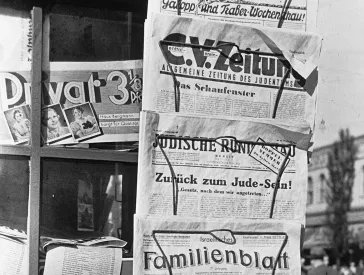
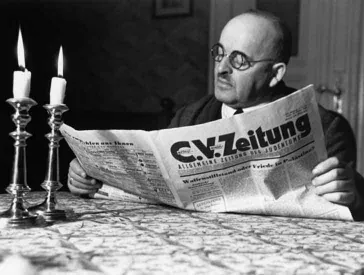
The family collections document both Jewish life and life in mainstream society, as well as experiences of exclusion, persecution, exile, and new beginnings. The collections focus on a range of themes, including middle-class life during the German Empire and Weimar Republic, the First World War, synagogues, business and economic history, Jewish sports, Jewish fraternities and student associations, schools and other Jewish institutions, Hachshara camps preparing young people for emigration, the emigration process itself, life in exile, persecution during the Nazi period, and the postwar era. This includes the rebuilding and reestablishment of organized Jewish communities, life in Displaced Persons camps, the return of individuals from exile, and the lives of Jews in divided Germany and, since 1989, in the reunified country.
As digitization work continues, more and more sources are becoming accessible. “The digitization of our archival materials and collection objects is one of the key priorities of the Jewish Museum Berlin’s digital transformation. However, this work will continue to depend on donations and external funding in the future,” said Hetty Berg.
A generous bequest from the Adler-Salomon family has enabled the Jewish Museum Berlin to lay the groundwork for digitizing its collections in order to educate future generations. This digitization milestone was made possible by this legacy, a partnership with Siemens AG, and support from the Berthold Leibinger Stiftung and Bertelsmann SE & Co. KGaA.
The Adler-Salomon family’s bequest is dedicated to the loving memory of those family members who were murdered in the Holocaust, and to acknowledging the lasting consequences that this history continues to have for survivors and their descendants to this day.
More information on the family collections is available here.