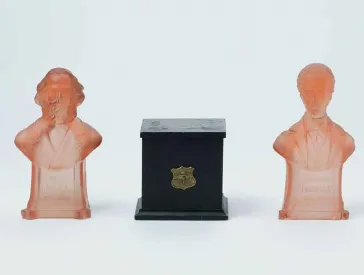
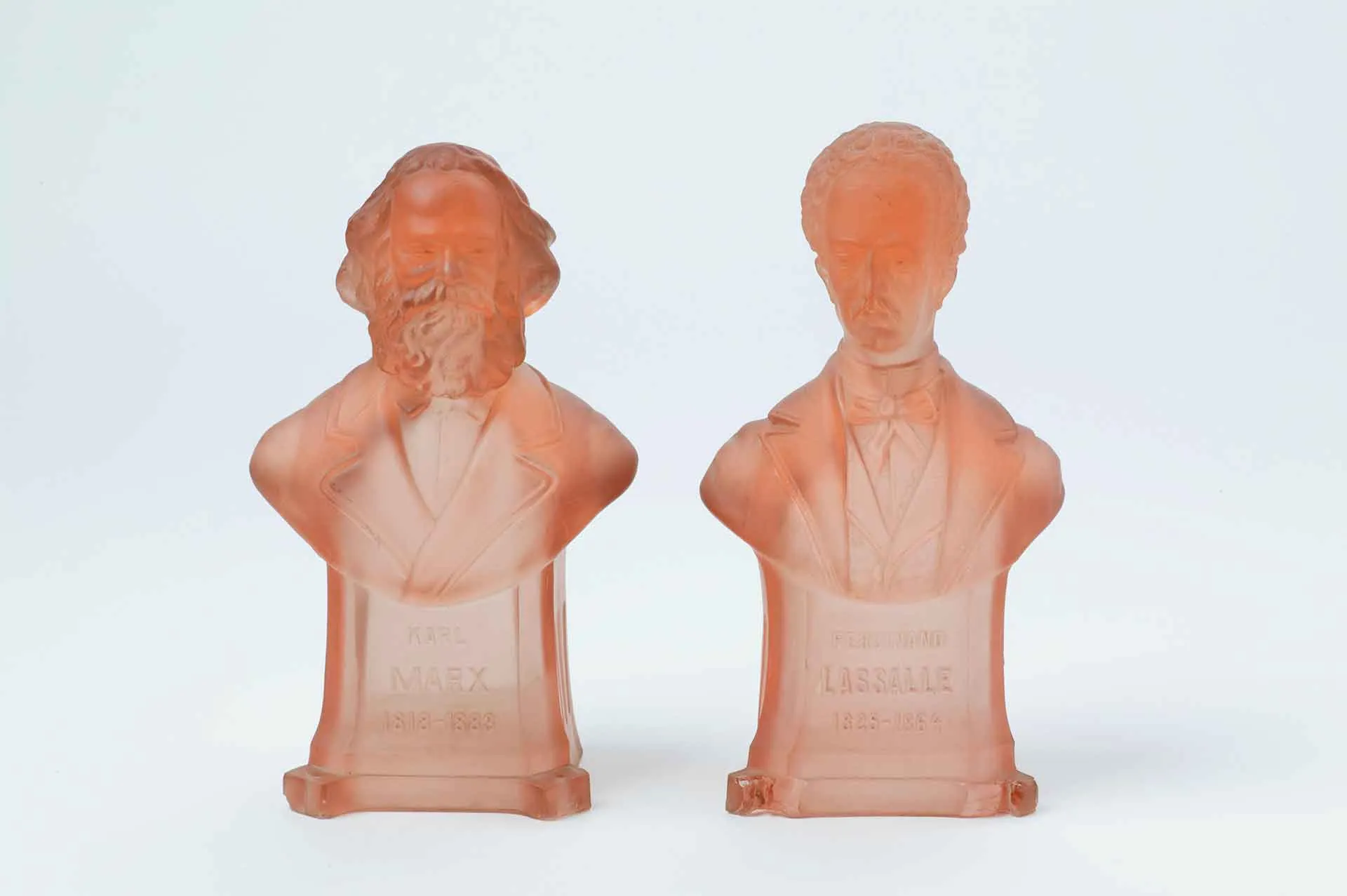
Portrait busts of Karl Marx (left) and Ferdinand Lassalle; Jewish Museum Berlin, photo: Jens Ziehe
“Now we’ll follow the intrepid path that Lassalle led us to!”
On the Anniversary of the Death of Politician and Publicist Ferdinand Lassalle
On 31 August, 1864 died Ferdinand Lassalle as a result of injuries sustained in a duel. The German politician and journalist was a founder of the first workers’ organization in the country, the General German Workers’ Association, which had come into being the year before his death and is today still considered “the birthplace of social democracy”.
Ferdinand Lassalle’s duel pistols were on display at the exhibition 150 Years of Social Democracy, presented in 2013 by the Moscow State Archive. Both a politician and a charismatic agitator for the organization of workers, Lassalle was only 39 years old when he challenged Wilhelm von Dönniges to a duel because the latter had refused to grant Lassalle his daughter’s hand in marriage.
After his abrupt demise, a veritable cult of personality developed around his memory: there were poems, songs, even rituals carried out during the widespread commemoration ceremonies, as well as various pieces of memorabilia that circulated among his followers. The first book with “An Exposé of the Tragic Death of Lassalle” appeared in 1868, by one of his close political comrades.
“Enthüllungen über das tragische Lebensende Lassalles” (An Exposé of the Tragic Death of Lassalle) by Bernhard Becker, Jewish Museum Berlin, photo: Leonore Maier
Portrait bust of Karl Marx (left) and Ferdinand Lassalle (1825–1864) with music box, ca. 1883–1900, Jewish Museum Berlin, photo: Jens Ziehe. Find more information on this objekct in the digitized holdings of our collection (in German).
Busts like those of Karl Marx and Ferdinand Lassalle were supposedly installed in union halls and assembly rooms. The copies in the Jewish Museum are made of industrial and molded glass respectively – and not revolutionary red, the color of the workers’ movement since the middle of the 19th century, but rather a delicate rose hue. This has to do with the manufacturing process: molded glass could be produced in lighter colors for a more reasonable price. The material suggests that the busts were made in large batches and widely distributed. We don’t know, in any case, whether there are more copies of the two busts, who the manufacturers were, or where they were produced.
The front side of the base of the Lassalle bust is decorated with the crest of the General German Workers’ Association that he founded – a hammer and two shaking hands symbolizing fraternization. Inside the base is a music box that places the Marseillaise.
Immediately following Lassalle’s death, Jacob Audorf worked up the popular and widespread Workers’ Marseillaise with five verses, the last line of which names Lassalle as a trailblazer: “Now we’ll follow the intrepid path that Lassalle led us to!” Sung for years by the Social Democrats at the closing of their conventions, among other occasions, the song was finally replaced by The Internationale during the Weimar Republic.
Portrait bust of Ferdinand Lassalle (1825–1864), ca. 1883–1900; Jewish Museum Berlin, photo: Roman März
During a guided tour through the old permanent exhibition celebrating the museum’s tenth anniversary in 2011, contemporary German politician Gregor Gysi introduced the busts as among his favorite pieces and later described the historical significance of Karl Marx and Ferdinand Lassalle in an interview.
Jewish Museum Berlin 2011
Leonore Maier, curator of the collection area Jewish Object: Material Culture
Citation recommendation:
Leonore Maier (2014), “Now we’ll follow the intrepid path that Lassalle led us to!”. On the Anniversary of the Death of Politician and Publicist Ferdinand Lassalle.
URL: www.jmberlin.de/en/node/10845