“It is especially people who make me curious”
Interview with Hetty Berg on the museum’s 25th anniversary
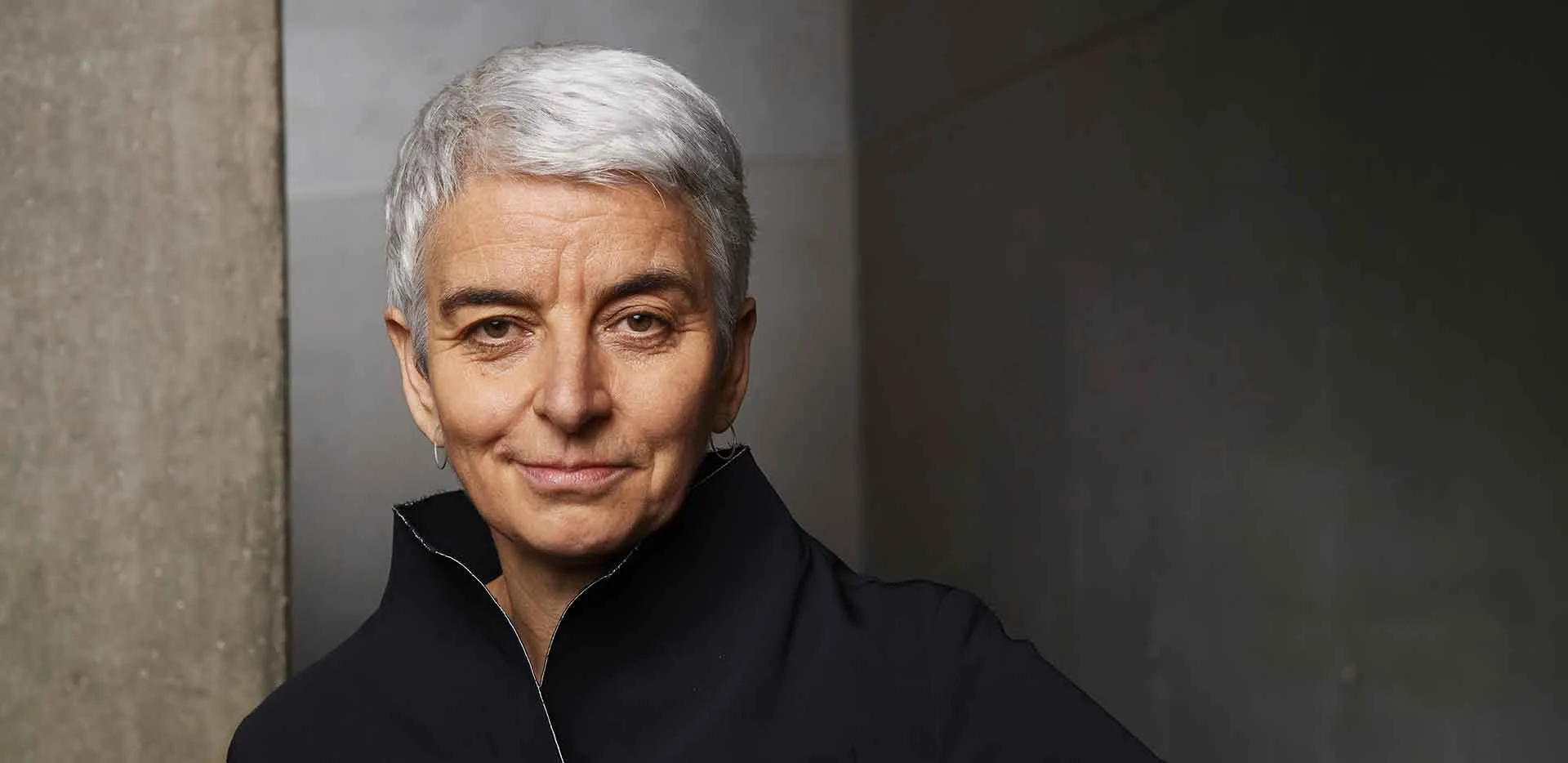
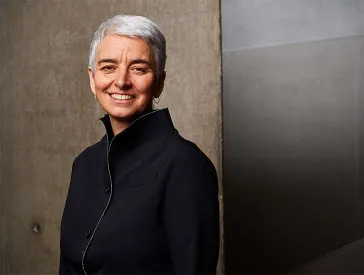
Hetty Berg assumed the directorship on 1 April 2020; Jewish Museum Berlin, photo: Yves Sucksdorff
25 years of the Jewish Museum Berlin (JMB) – Director Hetty Berg talks about the development of the museum from the beginnings to today, about what has been outstanding and challenging, and about what is necessary in shaping a positive future: multiplicity, an open mind, and curiosity.
Dear Hetty, what makes you curious?
People! Other people make me curious. I find interesting and particularly delightful what follows the initial perception, how someone can open up after the first impression! There is so much more to learn and discover. I often take a taxi and usually get into a conversation with the driver. I recently drove with a man from Togo. It turned out that he is learning Hebrew since he regards himself to belong to a lost tribe of Israel. We spoke a little Hebrew and he showed me some photos.
The JMB is celebrating its 25th anniversary this year. What are you looking forward to?
This anniversary is an occasion to direct attention to our museum in a special way and reach many people we have not reached so far. I’m looking forward to the many activities, programs, and exhibitions, but also to the campaigns that are accompanying everything. Within the scope of our digital project Jewish Places, for example, we are planning an interesting project in the public space: In selected cities we want to encourage people to collect information on Jewish places online.
Two exhibitions will be making strong statements this year: Between the Lines: Daniel Libeskind and the Jewish Museum Berlin, starting in May, reflects on the architecture, founding, and early positioning of the museum. And in September, The Opposite of Now: Artistic Paths to a Different Present will be focused forward, to ambivalences, controversies, and different options for changing the present. Also, the ANOHA Children’s World will be turning 5! We’ll be celebrating that birthday with a big party, which will be a real highlight! And then I am already looking forward to celebrating Hanukkah and looking back on an eventful and successful anniversary year.
Daniel Libeskind: Model for the new building of the Jewish Museum Berlin (“Names Model”), 1989–1991, 19 x 121,6 x 118,3 cm; Jewish Museum Berlin, accession N-2003/9/0, photo: Jens Ziehe
The JMB is considered a forerunner with respect to its educational and outreach programs. What formats are you enthusiastic about?
The educational work played a significant role in the JMB from the very beginning, and precisely in these times it is particularly important. We focus on a wide range of offers and approaches: We have a debate room in the core exhibition, where we show films that encourage visitors to reflect on and discuss discrimination and social diversity, which works very well.
In the JMB on.tour project, our facilitators visit school classes throughout Germany with a mobile exhibition, offering workshops for young people. Since the project began in 2007, more than 85,000 secondary school students have actively explored the diversity of Jewish culture, religion, history, and present. Within this framework, a true exchange takes place and various perspectives are discussed.
The same is true for the different thematic workshops and guided tours that are conducted in connection with our exhibitions and current social discourses, which the JMB offers for different target groups. It is always about participants engaging in a conversation with each other, and that is very important to me.
Hetty Berg, Director of the Jewish Museum Berlin, and Dr. Kristina Hasenpflug, Managing Director Deutsche Bank Stiftung; Jewish Museum Berlin, photo: Yves Sucksdorff
Digital options have also played a significant role since the founding of the JMB. Why do you think museums need to become involved in the digital world?
People are active more and more digitally so we have to be out there. If our content is part of the routine experiences of present and future generations, and if the JMB becomes the most important digital platform regarding questions of Jewish life in Germany, then we’re doing things right. We have offers for different target groups: on TikTok and Instagram, on our website, through Jewish Places, in the digital classroom JMB di.kla, and with digital and hybrid lecture formats. We make our collection digitally accessible in an attractive way, since it is possible to display only a fraction of the collection in the museum itself and not everyone can come and visit the museum.
The JMB opened in September 2001. On 11 September, our view of the world changed with the terrorist attack in the United States. In the time that you have served as the director of the JMB, you have experienced other instances of historical and sociopolitical upheaval. When you took over the museum leadership in 2020, the JMB – like all cultural institutions – was closed due to the pandemic. And since 7 October 2023, and its far-reaching consequences, Jewish communities are viewed differently than they were previously. How do such turning points impact the work of the museum?
One of our responsibilities is to engage with social developments. We enhance debates by adding their historical dimension and introduce many, often contradictory, Jewish perspectives. We do not define for our audience what to think , but instead impart knowledge, experiences, and arguments to allow visitors to form their own opinions. I see the JMB as an intermediary space between the Jewish and the non-Jewish worlds, as a space where these worlds can encounter each other, and as a mediator between them. This mediation process is not interrupted by the upheaval, it continues. The 7 October 2023, and the ensuing war was an example of such upheaval, and we have had to deal with it every day for almost three years. I am impressed that we have no difficulty speaking with each other in the museum, among colleagues. There are discussions, but no conflicts or condemnation; instead, there is space for different perspectives.
What in your view are the most important tasks today – the greatest challenges for the museum? Are they different than twenty-five years ago?
Twenty-five years ago, the JMB was at the center of Germany’s museum landscape. It was an expression of the spirit of unified Germany and of German remembrance policies that were viewed positively. When I assumed the position, I was told that our topics no longer touch the central questions of society. The politics of remembrance is no longer as uncontroversial as they were 25 years ago. On the contrary, the ways in which the Holocaust is addressed are being called into question, and the issue of colonialism has come to the forefront.
Since October 7, 2023, however, we are seeing that our themes are once again the focus of social discourse, but they now have a negative connotation. This in turn shows how important the JMB’s work is. That is why the JMB must reach more people in Germany, and that is why we are starting an education campaign. In order to address people more effectively with what we have to offer – both on-site and digital formats – we want to develop our methods and programs further. Our tours and workshops do not only serve to convey facts; we address the questions school classes and visitors have, and strengthen key democratic skills, such as critical thinking, media literacy, the ability to see things from different perspectives, and the ability to engage in dialogue.
You emphasize that “wherever we encounter antisemitism, we need to fight it with all means.” Can you give us an example of how that works – at the JMB or elsewhere?
Anyone who does not ignore an antisemitic remark and other discrimination, but counters it and says something, has taken up the fight. Much has been won if people become aware and start thinking about it, and at best it serves to break down the prejudices. That is the goal of our work. A Jewish museum expands the majority society’s view of the past and present to include the Jewish dimension that the Nazis wanted to eliminate and did in fact eliminate in part. Ultimately it is not just about hostility toward Jews, but fundamentally about hostility toward any groups or people. We present Jewish perspectives, but through that we are taking up democratic education. I hope that visitors to our museum develop an awareness for the mechanisms at the root of all types of hostility in order to counteract them.
The large amounts of money that have been invested over many years in projects opposing antisemitism have evidently not had enough impact. I think a lot more is accomplished if Judaism and Jewish history are addressed not only through negative concepts such as the Shoah and antisemitism, but rather also via positive concepts and by emphasizing the multiplicity of Jewish life. The JMB creates space for dialogue, for participation, critical reflection, and discrimination-critical learning. Viewing diversity as a value helps to strengthen social cohesion and democracy.
Curiosity drives us all. Museum work involves researching, presenting, explaining, telling stories. With every new exhibition, the visitors’ curiosity is both aroused and satisfied. In September, the museum will open its anniversary exhibition The Opposite of Now: Artistic Paths to a Different Present. What are you curious about as regards this exhibition?
About the different works by the individual artists and how they interact – and how the visitors react to the exhibition and the accompanying program! And whether our plan proves successful: that our audience engages with the often gloomy present, counters it with their own ideas, and seeks ways to bring about change.
How do you imagine “a different present”?
For me a better present would definitely be one in which people do not make judgments or even reject something immediately, at first sight. That is a vision that might not be all that difficult to implement and which would strongly influence the future. If you take time and look a bit closer, you can identify common ground, similarities, and differences between yourself and others. And that is precisely what is interesting! This has a lot to do with curiosity toward others.
What do you hope visitors take with them after having visited the museum?
I would be happy if their visit echoes and leaves them with a positive experience that moved them and that served – and serves – to encourage reflection, and as an encounter with other experiences and other people. In keeping with our overall concept to show Jewish perspectives, to encounter and move people. Here again, it is important to me that our visitors do not leave our museum only with the Holocaust on their minds. In the core exhibition there are 1,700 years of German-Jewish history and contemporary life to explore, with many lighthearted, joyful, and surprising elements.
Yael Bartana, Farewell, 2024, video still, courtesy of Annet Gelink Gallery, Amsterdam; Sommer Contemporary Art, Tel Aviv; Galleria Raffaella Cortese, Milan; Petzel Gallery, New York; Capitain Petzel, Berlin and Cecilia Hillström Gallery, Stockholm
Citation recommendation:
Marie Naumann, Katharina Wulffius (2026), “It is especially people who make me curious”. Interview with Hetty Berg on the museum’s 25th anniversary.
URL: www.jmberlin.de/en/node/10925
All Anniversary Specials
Accompanying Events & Tours
Family Sundays, Summer Festivals, Concerts, and More: All Dates At a Glance
Exhibitions
- Between the Lines: Daniel Libeskind and the Jewish Museum Berlin
- The Opposite of Now: Artistic Paths to a Different Present
Publications
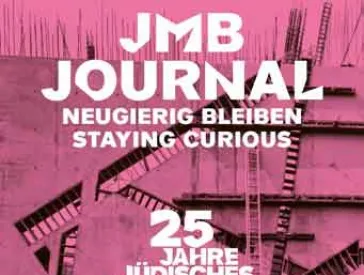
- Staying Curious!: the Anniversary Issue of the JMB Journal
- Current page: “It is especially people who make me curious” Anniversary Interview with Hetty Berg, Director of the Jewish Museum Berlin
Collections and Projects
- GLAM on tour at the JMB: Workshop Weekend in Collaboration with Wikimedia Germany
- Family Collections at the JMB: The Papers and Mementos of German-Jewish Families
See also
- ANOHA The Children’s World of the Jewish Museum Berlin celebrates its 5th anniversary!
- FRIENDS OF THE JMB: Partners for 25 Years: Learn more about the Museum‘s Friends
- di.kla The Jewish Museum Berlin's Digital Classroom
- Jewish Places Discover places of Jewish life in Germany!
- JMB APP: The Jewish Museum Berlin Audio Guide