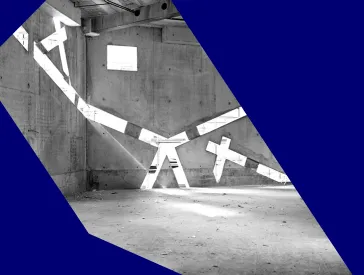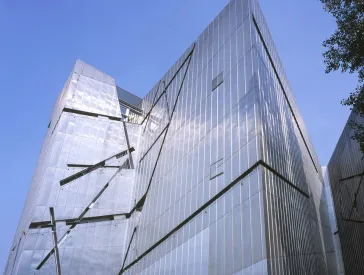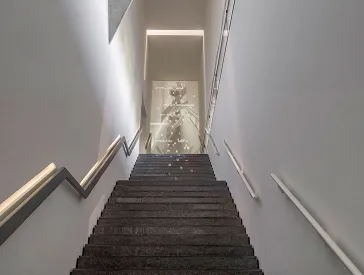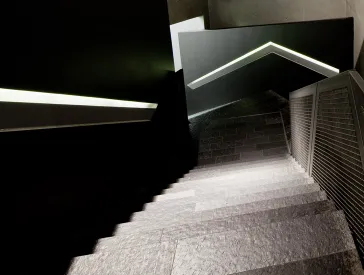


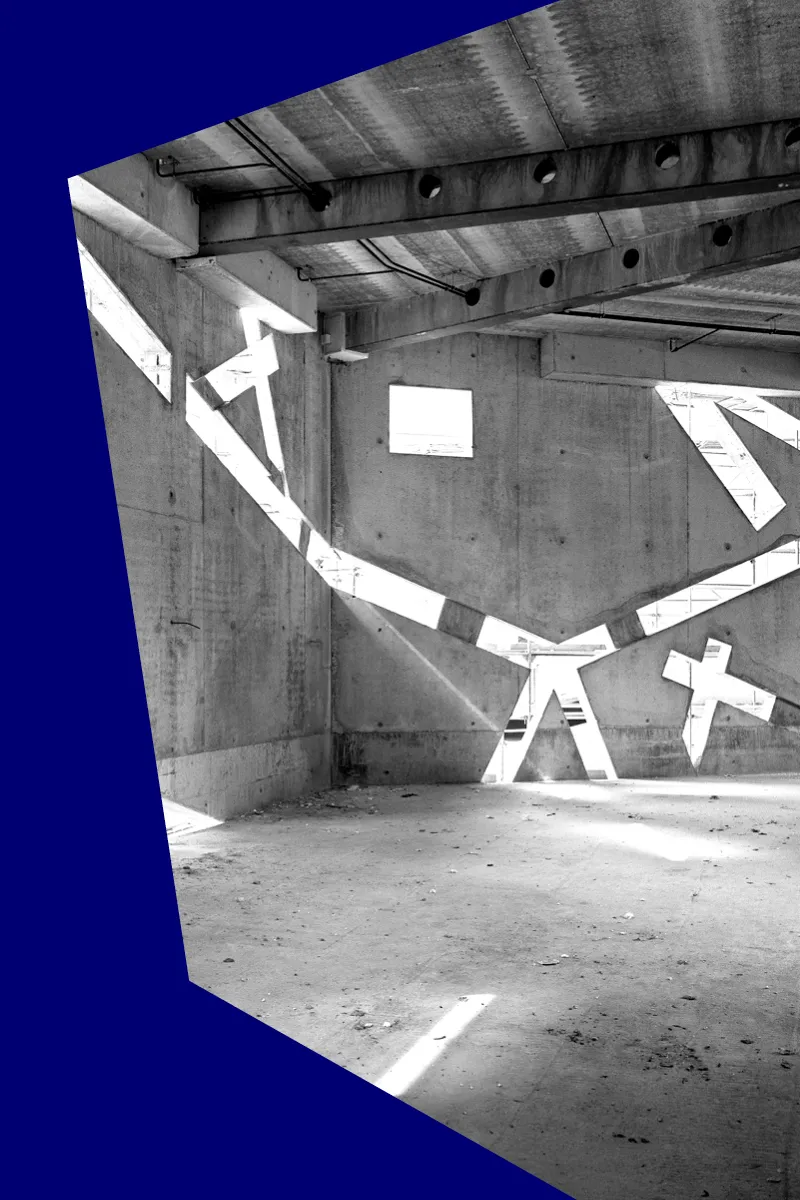
Silke Helmerdig, documentation of the construction of the Jewish Museum Berlin, 26 May 1995; Design: buerominimal
Between the Lines
Daniel Libeskind and the Jewish Museum Berlin – Exhibition
The striking zigzag building by New York architect Daniel Libeskind is one of Berlin’s most famous architectural works. To mark its 25th anniversary, the Jewish Museum Berlin is dedicating an exhibition to the building and the period in which it was created.
In the summer of 1989, Daniel Libeskind won the competition for the extension of what was then the Berlin Museum. His design went far beyond the original building brief: it combined architecture and Berlin’s history in a novel way and had a lasting impact on the public debate about remembrance, commemoration, and memory in Germany.
Thu 7 May to Sun 22 Nov 2026
Where
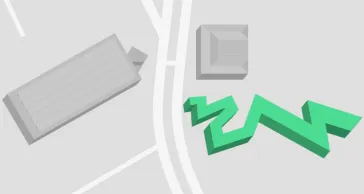
Libeskind Building, ground level, Eric F. Ross Gallery
Lindenstraße 9–14, 10969 Berlin
Glimpses Into the Exhibition
Using drawings and models, the exhibition provides insight into the creation process of one of the most influential contemporary museum buildings during the years of Berlin’s reunification. The collection exhibition shows how Libeskind’s design still contributes to the understanding of remembrance culture today.
Exhibition Information at a Glance
- When 7 May to 22 Nov 2026
- Entry Fee Free of charge
- Where Libeskind Building, ground level, Eric F. Ross Gallery
Lindenstraße 9–14, 10969 Berlin
See Location on Map

Information on the Accessability of the Exhibition
Languages:
- All exhibition texts are available in German and English.
- The most important exhibition texts are available in German Plain Language.
- We offer two public guided tours in German Sign Language (DGS). These can be found in our calendar: 26 Jul 2026 and 6 Sep 2026, 3 pm to 5 pm each.
Audio Guide:
- There is an audio guide in the JMB App (in English, German, French, Italian, Spanish, Hebrew, Russian). Please remember to bring your own headphones.
- The app includes texts to accompany the audio recordings.
- Links to download the JMB app, which you may download to your phone in advance (there are no devices available for loan):


- The stations in the exhibition are marked with numbers. The numbers are printed and not tactile. We recommend that blind and visually impaired visitors explore the exhibition together with a sighted companion.
- In addition to the exhibition tour, the JMB app offers further content on the architecture of the Libeskind building. This content is also available in German Plain Language.
- On the way to the exhibition in the axes of the basement, there is also a tactile model of the Libeskind building, with tactile instructions available in the JMB app.
Audio Station:
- There is an audio station (a conversation alternating between German and English).
- There is no hearing amplification in the form of induction loops and neck ring loops.
- The text of the audio station is available in German and English translations as reading material in the exhibition.
Exhibition Room:
- The exhibition is fully accessible without steps.
- Exhibits and exhibition texts can mainly be viewed and read while seated.
- You can always borrow wheelchairs in the museum lobby. You can also reserve a wheelchair by contacting our staff via besucherservice@jmberlin.de.
- Seating is provided in the exhibition.
- The objects in the exhibition are uniformly brightly lit. The exhibition texts are predominantly visually rich in contrast.
- There is no floor guidance system and there are no tactile models in the exhibition.
- There are no flashing lights in the exhibition.
- There are no loud ambient noises in the exhibition space.
Extensive information about accessibility can be found at Accessibility at the Jewish Museum Berlin.
Do you need more information on accessibility for your visit to the museum? Contact our visitorsʼ services staff, who will help you: Contact form.
Miriam Goldmann, Curator of the Exhibition, on Libeskind’s Building
-
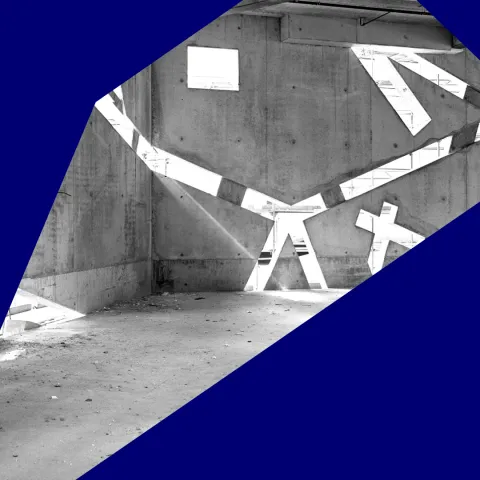
Curator Miriam Goldmann on the impact of Daniel Libeskind’s design for the Jewish Museum Berlin on the politics of memory (in German, for the English translation click “Read along”)
-
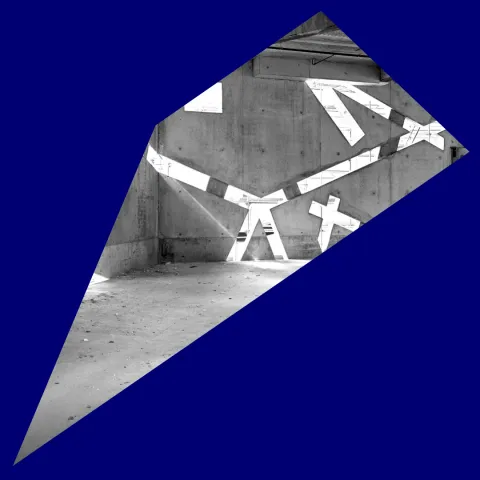
Miriam Goldmann on the visibility of the absent in the void
-
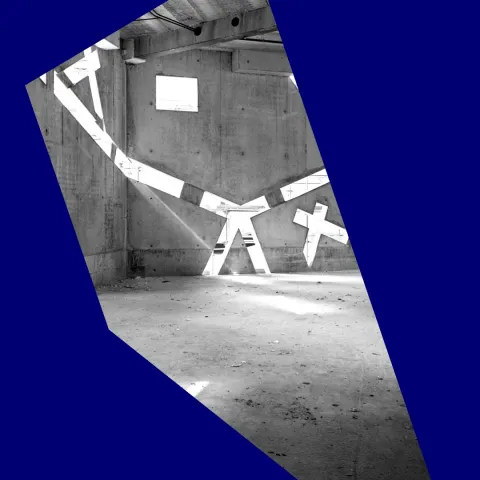
Wasn’t it most beautiful when empty? Curator Miriam Goldmann on the appeal of large spaces
Exhibition Between the Lines. Daniel Libeskind and the Jewish Museum Berlin: Features & Programs
Exhibition Webpage
Current page: Between the Lines. Daniel Libeskind and the Jewish Museum Berlin: 8 May to 22 Nov 2026
Accompanying Events & Tours
An evening with Daniel Libeskind, our JMB book club, film screenings, a panel discussion, and public tours: Find all dates in our calendar
Offerings for Groups
Bookable Tour of Daniel Libeskind’s Architecture: Tour by appointment, 8 May to 22 Nov 2026
Publications
JMB Journal #28: Staying Curious! The Museum’s 25th Anniversary Issue, among other things, features this exhibition.
Digital Content
- Interview with Daniel Libeskind: The architecture for the Jewish Museum Berlin and the power of rebellion and wondering, 2026
- Interview with the Exhibition Curator: Miriam Goldmann about memory culture and the poetics of architectural sketches
See also
- The Libeskind building: Architecture retells German-Jewish history
- Daniel Libeskind, architect
- How our museum came to be: Online feature in four parts, 2020
- Diagonal Line of Diversity: The Lindenstrasse in Berlin, caught between past and future, essay 2016
- 25 Years Jewish Museum Berlin: Discover our anniversary program, 2026
Supported by

Made possible by

Media partner