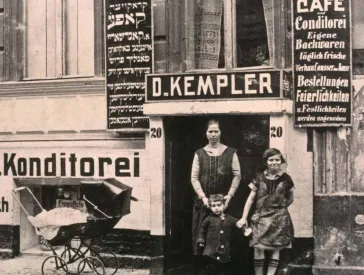


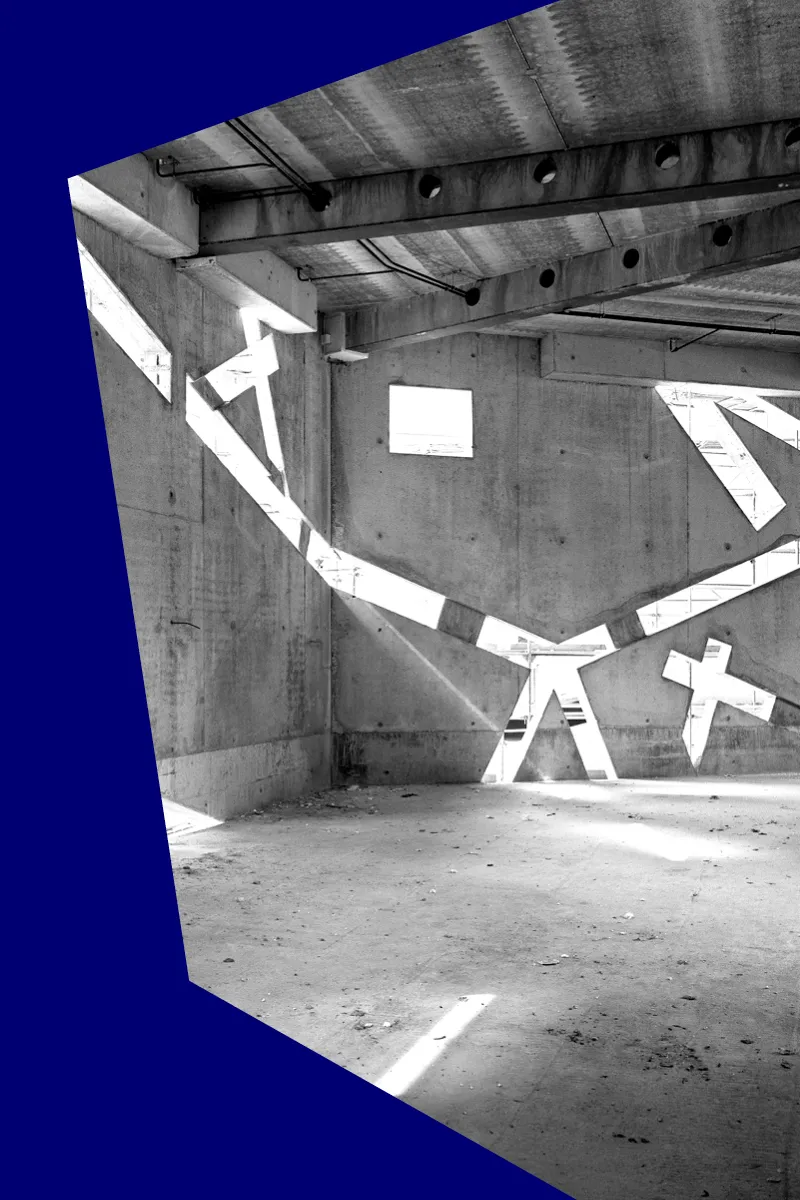
Silke Helmerdig, construction documentation of the Jewish Museum Berlin, 26 May 1995; design: buerominimal
“Looking forward without forgetting history”
Interview with Miriam Goldmann, Curator of the Exhibition Between the Lines: Daniel Libeskind and the Jewish Museum Berlin
From 8 May to 1 November 2026, we are presenting the exhibition Between the Lines: Daniel Libeskind and the Jewish Museum Berlin. In this interview, the exhibition’s curator Miriam Goldmann reflects on German remembrance culture in the late 1980s, Libeskind’s museum architecture as a welcome disruption, the presence of those absent, the delights of well-designed spaces, and the poetics of architectural sketches.
View from above of the Libeskind building, showing the Holocaust Tower and Garden of Exile; Jewish Museum Berlin, photo: Jens Ziehe
The exhibition you curated is in the very building whose architecture it showcases. Was that a stroke of luck or a challenge?
It is very unusual to see an architectural exhibition in the building the show is about. We decided to do it for the museum’s twenty-fifth anniversary. And it is a challenge, but an incredibly fun one. Hopefully visitors will make the connection and realize that they can identify the exhibition space they are standing in within one of the three models on display.
In an interview for our JMB app, Libeskind drew attention to the importance of light and darkness in the architecture of the Jewish Museum Berlin. Will visitors be able to experience this interplay of light and shadow in the exhibition?
The Ross Gallery, where we are showing the exhibition, has many beautiful Libeskind windows cutting diagonally through one wall. We are trying to open as many of them as we can, within the limitations of the very delicate paper model. We want the space to be as airy as possible, just as the architect designed it.
As for the question of darkness: the Ross Gallery is an elongated space, extending back to Menashe Kadishman’s installation Shalekhet, with its startling and vivid reference to the Holocaust. The light shifts again there, becoming less bright. That fits well. But it never gets truly dark or gloomy.
Memory Void, Shalekhet (Fallen Leaves) installation by Menashe Kadishman; Jewish Museum Berlin, permanent loan from Dieter and Si Rosenkranz, photo: Jens Ziehe
You mentioned the building’s relationship to the Holocaust. What did remembrance culture in West Germany actually look like in the late 1980s, before Daniel Libeskind’s design for the Jewish Museum Berlin won the competition, in 1989?
West Germany’s engagement with the Holocaust passed through many different stages. In the 1940s and 1950s, broadly speaking, Germans were not prepared to engage with that history in any way. And resentments against Jews, the fires of which the Nazis had vigorously stoked, were by no means gone. For example, the historian Joseph Wulf spent years unsuccessfully campaigning for the first memorial plaque at the House of the Wannsee Conference, which was not installed until 1972.
Perhaps it helps to remember that the general population first encountered the subject through a Hollywood production: the four-part U.S. series Holocaust, broadcast in 1979. That really did set things in motion. In 1982, three years later, a second, revised memorial plaque was installed at the House of the Wannsee Conference. The first debates about the Topography of Terror took place, and the film Shoah was released in 1985 and won an award at the Berlin Film Festival in 1986.
What is Holocaust/Shoah?
Shoah (Hebrew for catastrophe, disaster), Holocaust (Greek for burnt offering), two biblical terms to refer to the mass murder of approximately six million Jews across Europe during the Nazi regime, a crime unprecedented in history
What is Shoah (film 1985)?
Shoah, 1985, by Claude Lanzmann (1925–2018), runtime 566 minutes, cinematic testament to the systematic murder of European Jewry, completely avoids showing archival footage
In November 1988, the memorial on Berlin’s Levetzowstrasse was installed on the former site of a very large synagogue that, like many other synagogues, had been used as an assembly point for deportations. That same month, the Jewish Museum in Frankfurt opened, and the cornerstone was laid for rebuilding the New Synagogue in East Berlin.
All of these events centered on 9 November 1988, the fiftieth anniversary of the November Pogroms of 1938. The competition in which Libeskind took part was announced in December 1988 and decided in summer 1989.
What is “Kristallnacht” or November Pogroms?
“Kristallnacht” and “November Pogroms”, both terms for the Nazi’s violent acts against Jews, committed primarily in the night of 9–10 November 1938 throughout the German Reich
What changed as a result of Libeskind’s approach?
Libeskind engaged deeply with German and Berlin history. He was born in Poland, lived in Israel, moved to the U.S. as a high school student, and was educated there and in England. In the 1980s, he also lived and worked in Milan. But he came from a family of Holocaust survivors. That means, of course, that he did not come to Germany without preconceptions, but he did come as an outsider.
And with his perceptive eye and his learned background, he turned his attention to Germany. The building was intended as an extension to the Berlin Museum, West Berlin’s museum of municipal history. So he incorporated many aspects of Berlin, and German history more broadly, into his architecture, which he inscribed in the building.
In other words, he was by no means exclusively focused on the Holocaust. But he saw to it that a museum of city history could not forget the Holocaust. The subject is massively inscribed into the architecture of this extension, which is today the main building of the Jewish Museum Berlin – and I do think that is an achievement, he had an impact in that way.
Was that criticized?
Many people found this very unpleasant and wanted precisely the opposite. But that’s what he did, and thus he built on the existing groundwork for engaging with the German past and the Holocaust. His building was the first attempt to embed a message about the Holocaust into a museum building.
The competition jury was a kind of cross-section of society. As such, opinions were divided and there were heated discussions. But in the end, the design was so compelling that it was bound to win.
In a panel discussion in 1999, the chair of the jury at the time, the architect Josef Paul Kleihues, called Libeskind’s design “a welcome disruption.” Does that description resonate with you? In your view, what is productively disrupted, and how?
Well, German complacency, the ability to tune out anything burdensome. The disruption happens, and there’s no escape from it. You cannot experience this building without being confronted with the Holocaust.
Kleihues felt that disruption was welcome because he recognized the meaning of its cause and understood that perceiving the Holocaust in terms of its impact was a legitimate concern, and an important one for Germany.
View of the Libeskind building from Lindenstrasse, 2002; Jewish Museum Berlin, photo: Jens Ziehe
What perspective on Berlin and Jewish life in Germany is visible in Libeskind’s design?
Berlin was the nerve center where the murder of the European Jews was planned. That also reached Libeskind’s relatives in Poland. That is part of Berlin’s history, whether we like it or not. This idea was created, implemented, and planned here.
But Libeskind also engaged just as deeply with Berlin’s history and culture. That means he oriented himself around Berlin intellectual and cultural figures, both Jewish and non-Jewish, who contributed to the cultural and intellectual life of their times.
As for Jewish life in Berlin: I assume Libeskind had contact with the organized Jewish Community and with the Jewish community in Germany more broadly. He is, after all, a Jew who is aware of and open about his Jewishness. But it was not the only thing that interested him. Heinz Galinski, the head of the Jewish Community at the time, had to give up on his vision of a separate building for the Jewish Museum. But once he understood the ideas behind the building, he came to see what made it special and how important it was for Berlin and Germany. That is why he ultimately supported it.
Many things we take for granted today were anything but obvious in the late 1980s. And that was even before the Berlin Wall came down.
East and West Germany were reunified between the design being selected and its construction. Did these political upheavals affect the architecture or the use of the completed building?
The (West) Berlin Senate had announced the architecture competition. The Senate was the client, the owner of the Berlin Museum. It was the Senate’s building, and in 1989 it decided: yes, this design would win first prize, and yes, we want to build it. Then the Wall came down. In 1990, the Senate’s governing coalition of the SPD and Alternative List upheld the decision to realize the design. In 1992, they said that the project should now be implemented swiftly, with construction beginning by 1993 at the latest. And after that, the decision was firm.
Ten years after the fall of the Berlin Wall, the museum was under the stewardship of the Federal Government, no longer the Berlin Senate. Being a federal institution is usually advantageous for a museum as that status involves more secure funding.
At the exhibition’s core are various architectural models for the museum’s Libeskind building. One of them is called the “Names Model.” What is the story behind the names?
Unlike the standard “massing model,” with its clear design and material specifications intended to ensure comparability in the competition, this “Names Model” is the one Libeskind himself calls his competition model, because it embodies his idea, his concept.
Silke Helmerdig, construction documentation of the Jewish Museum Berlin, 23 Apr 1994; Jewish Museum Berlin, accession 2013/352/28/001
Daniel Libeskind, model for the new building of the Jewish Museum Berlin (“Names Model”), 1989–1991, engineered wood and cardboard covered with printed and gray-dyed paper, painted wood, metal, 19 x 121.6 x 118.3 cm (outer dimensions including protruding rod); Jewish Museum Berlin, accession 2003/9/0, photo: Roman März
The base is lined with paper printed with pages from the memorial book of murdered German Jews, which had been published by the German Federal Archives. These are deportation lists: always including a name and a date – the deportation date – followed by the German words for “missing” or “declared dead.” This makes the Holocaust reference very strong.
The model and the others on display clearly show the Voids that run through the building. Can you say something about these empty spaces?
Libeskind sliced the zigzag-shaped building with a single straight line and left “Voids” – empty spaces – at the points where the lines intersect. Architecturally, that is also fascinating, because you cannot really build emptiness. You have to build around it. He cut shafts into the building, so to speak, extending from underground up to the roof, slightly offset from one another. That creates interesting spaces. In these Voids, then, emptiness manifests itself and marks what is no longer present in Berlin and Germany. This dedicates space to the absent, the missing Jews and those declared dead.
Making the absent visible is one of Libeskind’s fundamental ideas. The title Between the Lines points precisely to the fact that between objects, between the words and information we deal with, there is always another space that can hold meaning. This is connected to Jacques Derrida’s “Writing Architecture,” to which Libeskind has strong theoretical links.
Interior view of the Holocaust Tower in the Libeskind building; Jewish Museum Berlin, photo: Jens Ziehe
In addition to the models for the Jewish Museum Berlin, the exhibition also displays another model that Libeskind submitted for another competition in 1993: the plan to develop the “Former SS Barracks Complex at Sachsenhausen.” Why did you decide to include this model in the exhibition as well?
Many years passed between Libeskind’s design winning the competition in 1989 and the opening of the Jewish Museum Berlin in 2001. During that time, in 1993, the city of Oranienburg announced a competition for the urban redevelopment of the former SS military complex near Sachsenhausen concentration camp, from where all European concentration camps were administered. There was apparently a housing shortage in Oranienburg, so the city considered building dense urban housing at this very centrally located site—and specifically invited Libeskind to submit a proposal.
Libeskind did so, but he was quite dismayed by the entire situation. The camp had been horrific, the site was terrible, and he found the whole concept difficult to understand. So he presented a design that was intended to give space to history. He wanted to put large parts of the site under water and plant trees, and then also build something – but not just conventional residential housing. Most of all, he proposed municipal buildings, based on the idea that the residents of Oranienburg somehow needed to engage with this history before thinking about the future.
Daniel Libeskind: “Development of the Former SS Barracks Complex at Sachsenhausen Concentration Camp” competition model, Berlin, 1993, wood, metal, paper, plastic, 24 x 162 x 113.8 cm; Jewish Museum Berlin, accession 2026/47; courtesy of Studio Libeskind, photo: Roman März
As we know, we are haunted by what we do not say out loud. So it is wiser to engage with these things so we can reach a place where we can think ahead. Fundamentally, it is not in Libeskind’s nature to continually look back at negativity. His architecture is always future-facing too; it looks forward without forgetting history.
And did his idea succeed here as well?
The jury awarded the first prize to an Austrian architect who proposed massive development, with ten thousand housing units, including space for municipal uses. I think that would have amounted to one-fifth of Oranienburg’s population. But the city was taken with Libeskind’s idea and awarded him a special prize, bypassing the jury, so to speak.
One statement by the jury is especially astonishing, that they had not awarded Libeskind a prize in part because implementing his plan would have “retraumatized the people of Oranienburg.” That is another indication of the range of attitudes that were still very common in Germany, and the level of resistance to engaging with this history. Of course no one, certainly not Libeskind, would claim that all the people of Oranienburg were personally involved in planning concentration camps or murdering Jews. But it happened right before their eyes, and presumably some locals were involved with these concentration camps in various ways.
The impasse in awarding the prize was complicated by the fact that Brandenburg’s state monument preservation authorities and the emerging memorial group also had a say. Incredibly, Daniel Libeskind and the manager of his firm, the architect Matthias Reese, invested an enormous amount of time in talking with the city and the monument preservation office to find more viable solutions. But ultimately, the project failed because of the financing.
And what is on the site today?
There have been no major structural changes. As far as I know, the tax office of Oranienburg is now located in the “T-Building.” And then there are barracks, accommodations for the SS troops, which were largely built by concentration camp prisoners like most buildings on the site. Some of these buildings are used by the Brandenburg Police Academy. But the academy works closely with the memorial, which incorporates the subject extensively during police training. Despite this reflective approach, it is bizarre that the site is still being used.
Silke Helmerdig, construction documentation of the Jewish Museum Berlin, 23 Apr 1994; Jewish Museum Berlin, accession 2013/352/28/001
You said earlier that Libeskind also builds for the future. His building has now been in place for twenty-five years. In a sense, we are the future people were imagining back then. In your experience with visitors, has the building retained its fascination?
The building is still working very well after twenty-five years, especially its basic idea of making the absent visible and present in the building. Form and content simply come together particularly well here.
Selected Interview Excerpts as Audio
-
Curator Miriam Goldmann on the impact of Daniel Libeskind’s design for the Jewish Museum Berlin on the politics of memory (in German, for the English translation click “Read along”)
-
Miriam Goldmann on the visibility of the absent in the void
-
Wasn’t it most beautiful when empty? Curator Miriam Goldmann on the appeal of large spaces
As a curator who regularly creates exciting exhibitions in this building, what do you say to people who still insist the Libeskind building was most impressive when it was empty?
I can understand that, because architecture can be extraordinarily fascinating, and we all experience large, empty, but well-designed spaces far too rarely. I know this from very small children who have only just become able to move around freely. When you take them into large spaces, it has an effect: they sometimes run off, shouting with joy. And we do that too, in a more moderate form. Spaces excite us too.
In the past, these spaces might have been churches, which often have beautiful architecture and attracted people not only as communal and religious spaces but perhaps also because they were good places – with comforting proportions and design. What are the large spaces today? Perhaps libraries, public spaces, airports, which are usually not very beautiful and very rarely have interesting architecture. And, of course, museums.
So I understand the idea that it was at its most beautiful empty. But that was not the purpose of this building. Neither the Senate nor the federal government wanted the building to remain empty, nor did the architect. And of course the people running the museum did not, because we have entirely different things in mind. Libeskind does indulge in the luxury of space, and there are nooks and crannies that are difficult to use. But by and large, the building functions well as a museum.
Which of the items on display fascinated or surprised you most during your research for the exhibition?
It is a tightly focused, clearly structured exhibition, with everything revolving around this building. What did surprise me, and what I greatly enjoyed, was looking closely at Libeskind’s design drawing, because he wrote and distilled so much into it. For me, it has a poetic quality. He draws on a rich store of knowledge, and that is also evident in these plans. For example, there is a long Hebrew quotation from Jeremiah that he wrote out himself, very precisely, over a length of three meters.
At the time, the city was very surprised that Libeskind inserted the Holocaust so prominently into his design, and a culture of remembrance was only just emerging, often from the bottom up through citizens’ initiatives. Today, there seems to be a discrepancy between an apparent oversaturation of Holocaust remembrance and a factual lack of knowledge about its history. What can we as a museum, and what can you as a curator, do to ensure that engagement with this subject does not remain formulaic or seem like a top-down imposition?
We have been talking about this subject for a very long time, but new generations are always growing up. And it is not about being able to recite the dates somehow. It is more about the understanding behind them. And the basic lesson that can perhaps be drawn from the Holocaust – namely, granting all people the same right to live freely and pursue their personal choices – may have to be learned afresh by every generation. Museums can participate in this process.
The Jewish Museum Berlin is concerned with the history and present of Jews in Germany, but visitors can experience and learn something here that is generally human and can also be applied elsewhere. We have the opportunity to work through the subject of human diversity again and again using different topics and areas of life. We can create understanding for other people and for their right to be different from ourselves. Many museums can do that, not only the Jewish Museum. I see that as extremely important for preserving and nurturing the capacity for empathy.
Thank you very much for this fascinating conversation.
The interview was conducted by Mirjam Bitter, Online Editor.
Citation recommendation:
Mirjam Bitter (2026), “Looking forward without forgetting history”. Interview with Miriam Goldmann, Curator of the Exhibition Between the Lines: Daniel Libeskind and the Jewish Museum Berlin.
URL: www.jmberlin.de/en/node/10951
Exhibition Between the Lines. Daniel Libeskind and the Jewish Museum Berlin: Features & Programs
Exhibition Webpage
Between the Lines. Daniel Libeskind and the Jewish Museum Berlin: 8 May to 22 Nov 2026
Accompanying Events & Tours
An evening with Daniel Libeskind, our JMB book club, film screenings, a panel discussion, and public tours: Find all dates in our calendar
Offerings for Groups
Bookable Tour of Daniel Libeskind’s Architecture: Tour by appointment, 8 May to 22 Nov 2026
Publications
JMB Journal #28: Staying Curious! The Museum’s 25th Anniversary Issue, among other things, features this exhibition.
Digital Content
- Interview with Daniel Libeskind: The architecture for the Jewish Museum Berlin and the power of rebellion and wondering, 2026
- Current page: Interview with the Exhibition Curator: Miriam Goldmann about memory culture and the poetics of architectural sketches
See also
- The Libeskind building: Architecture retells German-Jewish history
- Daniel Libeskind, architect
- How our museum came to be: Online feature in four parts, 2020
- Diagonal Line of Diversity: The Lindenstrasse in Berlin, caught between past and future, essay 2016
- 25 Years Jewish Museum Berlin: Discover our anniversary program, 2026