
Note: We deliver all images in WebP format. Since September 2022, all modern browsers are supporting this format. It seems you are using an older browser that cannot display images in WebP format. Please update your browser.

From Berlin to Cape Town and Back

Object Showcase

In 2004, concert pianist Tessa Uys donated her late mother Helga Bassel’s grand piano to the Jewish Museum Berlin (JMB). In 1936, Bassel had fled the Nazis with the instrument, taking it to South Africa.

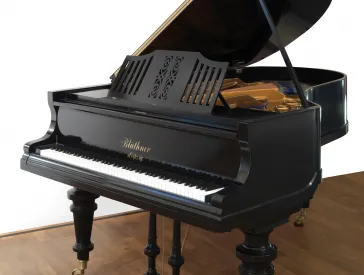
Blüthner grand piano formerly owned by Helga Bassel (1908–1969); Jewish Museum Berlin, gift of Tessa Uys, photo: Jens Ziehe. View this object in the digitized holdings of our collection (in German)

A Pianist from Berlin

The black grand piano, a parlor grand manufactured by the Julius Blüthner piano factory in 1913, features gold lettering on the inside of the lid and an ornate fold-up music stand. Helga Maria Bassel purchased the piano from the Berlin-based company Hans Rehbock & Co. in 1930 for 2,350 Reichsmarks.

Bassel, born in 1908, studied at the Berlin Academy of Music, where her teachers included the renowned piano virtuoso Leonid Kreutzer. Bassel also gave piano recitals outside Berlin. Our collection includes a review of a concert she gave at the Volksbildungsverein (adult education association) in Limburg.

Leonid Kreutzer (1884–1953)

Pianist, piano teacher, and member of the honorary executive board of the Kulturbund Deutscher Juden (Cultural Federation of German Jews)
More on Wikipedia

A Career Cut Short by the Nazis

Helga Bassel’s fledgling career as a pianist came to an end when the Nazis came to power. From then on, she worked exclusively as a piano teacher. Around 1930, when she purchased the grand piano, she was already advertising her services as a piano teacher on a business card that read:

“Piano lessons / for / beginners and advanced students / group music lessons / for children (Tonika Do method) / taught by / Helga Bassel / state-certified piano teacher / (Berlin Academy of Music; student of Kreutzer) / Berlin-Charlottenburg / Neue Kantstraße 16 / Tel. J 3 Westend 4092”

In June 1933, she left the Jewish community and converted to Christianity. Despite this, she was expelled from the Reichsmusikkammer (Reich Chamber of Music) in 1935.

Reichsmusikkammer (Reich Chamber of Music)

A Nazi institution tasked with bringing musical culture into line with Nazi ideology and excluding music classified as “degenerate”
More on Wikipedia

Emigration to South Africa

In 1936, Helga Bassel emigrated to South Africa with her grand piano. Her parents joined her there in 1939. In Cape Town, she married the organist and choir director Hannes Uys and started a family.

She never spoke about her Jewish past. It was not until 2003, long after Bassel’s death in 1969, that her daughter, the pianist Tessa Uys, learned that her mother was Jewish.

The Piano Returns to Berlin

After learning of her mother’s Jewish heritage, Tessa Uys offered to donate the instrument to the Jewish Museum Berlin in 2004. With support from the FRIENDS OF THE JMB, the grand piano was transported and restored so that it could be used in concerts as part of the museum’s cultural program. 

The grand piano was played, for example, in three shows by the satirist and activist Pieter-Dirk Uys, Helga Bassel’s son and Tessa Uys’s brother, held at the JMB in 2007, 2011, and 2017.

Pieter-Dirk Uys

South African satirist, comedian, author, and social activist, born 1945 in Cape Town
More on Wikipedia

Ari Benjamin Meyers, Choir of the Time Astronauts, 2026, from the exhibition The Opposite of Now. Artistic Paths to a Different Present; Jewish Museum Berlin, photo: Roman März

The grand piano is currently being used to accompany a choral performance by Ari Benjamin Meyers in our 2026 anniversary exhibition The Opposite of Now. When the Choir of the Time Astronauts isn’t rehearsing, a figure of an astronaut sits at the keyboard in the exhibition gallery.

Title

Blüthner grand piano formerly owned by Helga Bassel (1908–1969)

Collection

Material Culture

Location and year of origin

Leipzig, 1913

Medium

Wood, metal, ivory, cast iron, steel, felt

Dimensions

98.2 × 149 × 220 cm

Acquisition

Gift of Tessa Uys with the support of the FRIENDS OF THE JMB

Selected Objects: Collection Jewish Object: Material Culture (11)

  • Collection Jewish Object: Material Culture

    An unusual wedding gift, practice signs from half a century ago, a carnival hat, and more: discover exciting stories in our Material Culture collection! 

  • Blue and white flag with Star of David on the blue background.

    Flag with the Star of David

    In 1935, Martin Friedländer hung a blue and white flag from his window, making a confident statement against the racist Nuremberg Laws

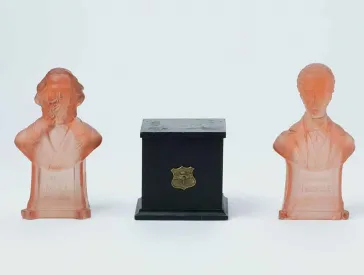
  • Two busts made of red, transparent glass. The one on the left depicts Karl Marx, the one on the right Ferdinand Lassalle. Between them is a dark brown wooden music box.

    “Now we’ll follow the intrepid path that Lassalle led us to!”

    On the Anniversary of the Death of Politician and Publicist Ferdinand Lassalle

  • Model of a ship.

    Model of the Cargo Steamer Max

    The Hamburg shipowner Arnold Bernstein received this model of his first ship in 1929 as a gift for his company's tenth anniversary. Eight years later, his career ended abruptly. He was detained and only managed to escape Germany at the last minute

  • Photo of three medals on a velvet cushion.

    Max Haller’s Collection of Medals

    Max Haller fought in the First World War for the Imperial German Navy. When SA members threatened him during the April Boycott of 1933, he pointedly placed a velvet cushion with his military distinctions in the shop window

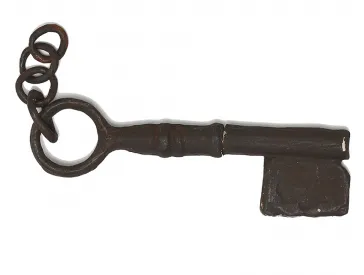
  • Dark-brown cardboard key containing a rolled-up piece of paper

    Cardboard Key for the Korants’ Wedding

    Margarete Apt and Georg Korant received an unusual gift for their wedding on 4 October 1903 in Breslau. The dark brown key is made of cardboard and can be opened

  • A blue sign with text.

    Dr. Oscar Hirschberg’s Office Signs

    A total of seven office signs used by Dr. Oscar Hirschberg document both his career as a practicing physician and the political changes and antisemitic exclusion during the period of Nazi rule

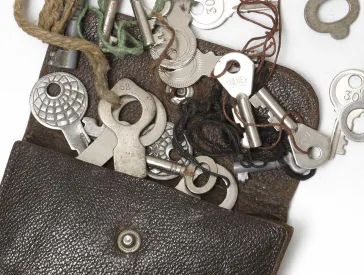
  • Brown-leather wallet with thirty-one keys spread out.

    The Sommerfelds’ Thirty-One Keys

    Thirty-one keys – that's all that remains of the luggage the Sommerfeld family took with them when they emigrated from Berlin. They only managed to leave for England at the very last minute – just before the Second World War broke out

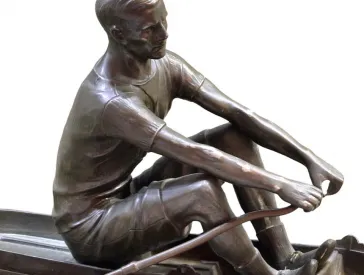
  • Bronze statue of a rower.

    Challenge Trophy from the Oberspree Jewish Rowing Club

    The member of the Oberspree Jewish rowing club who logged the most kilometers in the water over the course of a year was awarded a challenge trophy. Fred Eisenberg won the award three years in a row

  • Black grand piano with its lid open

    From Berlin to Cape Town and Back

    Concert pianist Tessa Uys donated this grand piano belonging to her mother, Helga Bassel, when she found out that her mother was Jewish

  • mask with glued-on dreidel made from beads

    Masks? Cool!

    Europe-wide Competition of the Ronald S. Lauder Foundation: Children Turn Masks into Pieces of Art

  • Handmade blue-white-red "Krätzchen" of the Köllsche Kippa Köpp Jewish carnival society, left side open

    Collecting the Present

    Krätzchen Carnival Cap (Kölsche Kippa Köpp Carnival Society), gift of Aaron Knappstein, 2019

Links to topics that may be of interest to you