

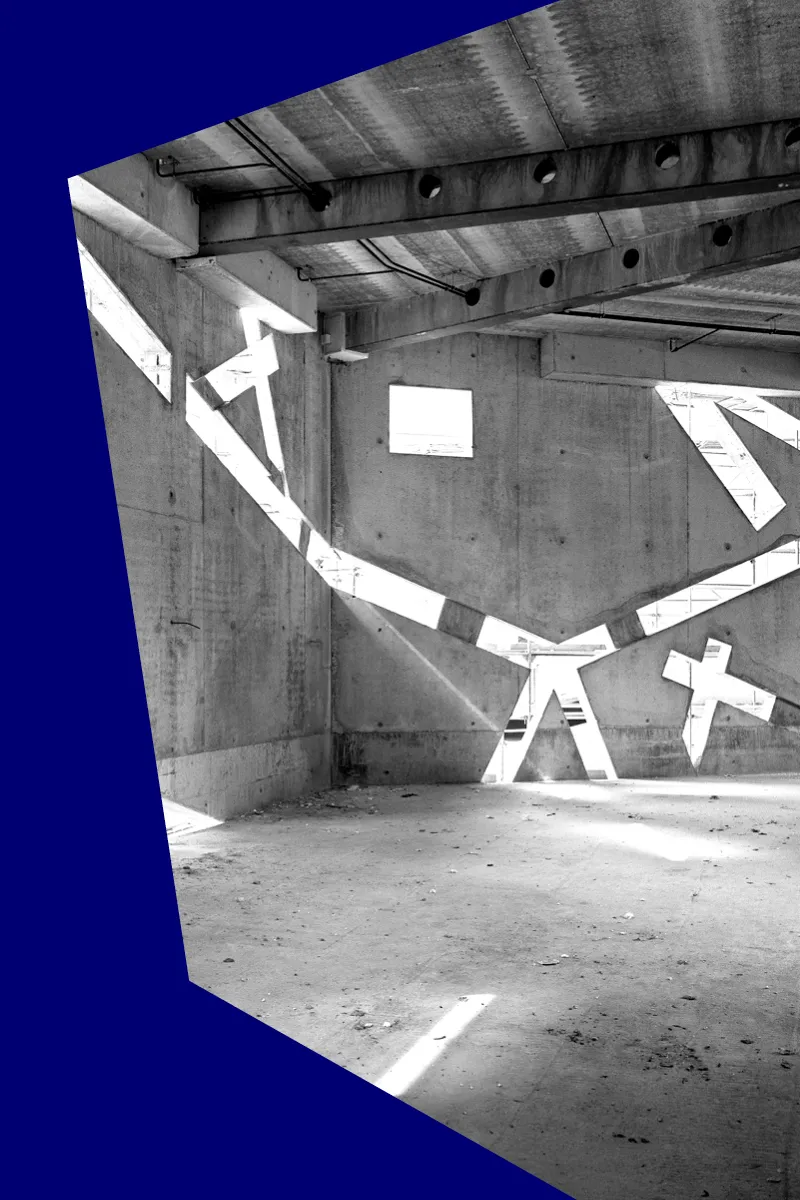
Silke Helmerdig, documentation of the construction of the Jewish Museum Berlin, 26 May 1995; Design: buerominimal
“Don’t conform, don’t obey, do something else, rebel!”
Interview with Daniel Libeskind
Daniel Libeskind was born in Poland in 1946 to Holocaust survivors. The family emigrated, first to Israel, then to the USA. Despite his musical talent, Libeskind decided to study architecture at the Cooper Union in Manhattan and the University of Essex in England.
As an architectural theorist, Libeskind continues to pursue a multidisciplinary approach. He has long been known for his artistic architectural drawings and models, in which he makes no distinction between theory and built projects.
Your main sketch of the Jewish Museum Berlin (JMB) includes many writings and references, among them a quote from Jeremiah 12:7. Why did you choose this specific passage?
That passage deals with desolation:
“I have forsaken My house, I have cast off my heritage; I have given the dearly beloved of My soul into the hand of her enemies.”
When I designed the sketch in the late 1980s, it struck me as being descriptive of what I felt Berlin looked like. And in a way, these words are a description of a Void. But these biblical passages are so multifaceted that they refer to almost everything at any time! Any passage in Jeremiah could be a prism through which to see many other things that went on in my head while designing the building.
Daniel Libeskind, Close-up with the new building’s facade in the background, 2021; Jewish Museum Berlin, photo: Yves Sucksdorf
Besides this biblical quote you include very poetic pieces from Walter Benjamin’s Einbahnstrasse: You mention all the buildings and places that he listed in the fragment “Reiseandenken”. Why?
Well, I designed an imaginary installation in my drawings: They were not just empty plans but had so-called “exhibits” inside them. I tried to use Einbahnstrasse and to reverse its direction through the topography of the museum, to relate Benjamin’s particular destinations to a reversal of his One-way Street. As if one was seeing it from the other side, through the museum.
That was at least my general inspiration! Benjamin’s description of Berlin to me was very relevant and continues to be so.
In 1985, some years before you won the competition for the Jewish Museum Building, you presented the installation Three Lessons in Architecture. The Machines: Each of these machines, The Reading Machine, The Memory Machine, and The Writing Machine, refers to a specific era. There is a connection of The Writing Machine to the JMB; could you explain its role?
There are many connections, but the most physical one was that I tried to build its equivalent in what is today the Garden of Exile. There’s a strong relation between exile and writing; really, exile exists purely in writing. This is what The Writing Machine implies. Later, I transformed it because, of course, it required a very different approach in a building rather than in an art installation.
Garden of Exile; Jewish Museum Berlin, photo: Jens Ziehe
Why are you so fascinated by machines? Which machine would you build today?
Le Corbusier said the house is a machine to live in. But what kind of machine is a house? Is it the machine that Le Corbusier invented, which is a kind of technological, functionalistic idea of the human body, or is it really to do with memory, with writing, and reading?
So, what kind of machine would I construct today? Probably the memory of the memory, the writing of the writing, or the reading of the reading machine. As we live in the era of AI robots are all around us!
Your work is inspired by all kinds of different ideas, from literature to music to history. How would you describe your profession without using the word architecture?
Well, it’s one of the liberal arts. You know, people think mathematics, geometry, science, and all these are the main necessities in architecture. But I say my work is one of the liberal arts because liberal means free, and architecture is an art of freedom. It’s not something just bound by gravity. And many people forget that architecture is closely connected with freedom of thought in a democratic sense.
Could you explain this connection between architecture and democracy?
Every piece of architecture, even the pyramids, must have a door. So, it’s always about the other, about somebody else entering. That is the beginning of a thought of the other. And this thought is the beginning of democratic sense: Who is the other, who are the others? How are we to relate in a civilized way?
We can see the disasters that are on the horizon today across the world – they have a lot to do with closed doors, with marginalization and segregation.
We know that music plays an important role in all your doings. How is it implemented in your architecture of the JMB?
I was very interested not just in Schönberg’s Moses and Aaron, which I tried to incorporate in the geometry of the building, but that aside, I tried to understand the acoustical space. I constructed a model with the idea of being able to play it like an instrument, a model you could hit and experience the function of the voids in relationship to all other spaces as sound. To me, the ear, when it comes to orientation, is much more important than the eye; the ear provides our sense of balance.
There are several Berliners and Germans, among them not only Walter Benjamin but also Rahel Varnhagen, Paul Celan, and Heinrich Heine included in your design of the JMB; you call them Geistige Entität, or spiritual entity. What do these specific people – some Jewish, some converted to Christianity – have in common?
I had delved deeply into Berlin’s history and long knew many of these characters. I wanted to bring them into one site, to show this idea of an “intermarriage” of culture, to show how these different people really created this entity we call Berlin and Germany, and the 20th century. It was a sort of chemical process to bring them close together. You take an address, you take a piece of geometry, you intersect them and find out: what does it give you within the museum’s space? Maybe a window, a view, an angle of memory?
Which model is it exactly that would give you a sound? Aren’t they all from paper and soft material that doesn't really give off sound?
Even paper, even cardboard makes sounds! You know, if you listen, even a piece of crumpled paper when it's unwound becomes alive.
We’ll try to get an unobserved moment with the model and see what noises we can create!
Daniel Libeskind: Model for the new building of the Jewish Museum Berlin (“Names Model”), 1989–1991, 19 x 121,6 x 118,3 cm; Jewish Museum Berlin, accession N-2003/9/0, photo: Jens Ziehe
With your architecture, and especially with the Jewish Museum, you manage to translate the historical rupture of the Holocaust into buildings. In a certain way, you did the same in a project dedicated to the urbanization of what formerly was an SS-camp in the town of Oranienburg north of Berlin: Your design proposal focused very strongly on the history of the site, with the result that this history cannot be ignored any more by anyone involved. Is there a process that leads you to this very impressive effect?
I really think – and have always thought – that after the events of the Shoah and after Hiroshima, the world is radically different. We cannot think in the same ways about reality, history, and continuity. Those events require a completely new way of looking at history, looking at physical space, at sites, and how to go on with them. Architecture, too, has changed completely and in historical sites there is something that must be addressed, something which is there, which is no longer like what it was in the past. These spaces cannot just continue to be developed in the same way.
What is Holocaust/Shoah?
Shoah (Hebrew for catastrophe, disaster), Holocaust (Greek for burnt offering), two biblical terms to refer to the mass murder of approximately six million Jews across Europe during the Nazi regime, a crime unprecedented in history
If you were to build the Jewish Museum today, what would you change?
I would build the Voids larger and the bridges that cross them narrower; I think my idea of the Void of a means to address the physical emptiness that resulted from the expulsion, destruction, and annihilation of Jewish life in the Shoah is true, and it has increased its importance in the post-Holocaust world. Today, we see that it was an illusion to think the end of the Holocaust would be the end of antisemitism. The Voids need to be bigger.
The Voids impress every visitor to the JMB. What should architecture be capable of and convey?
I think it should be able to embody in your experience something that cannot be put into words, something that is not information that could be read or given. It should embody something you must experience in space and in time, and not only intellectually.
Memory Void with the installation Shalekhet by Menashe Kadishman; Jewish Museum Berlin, photo: Jens Ziehe
Fortunately, the Jewish Museum Berlin has a large audience. What would you like to ask our visitors who often spend hours in your building?
If you are not Jewish, do you have an idea of Jews and what it means to be Jewish after you experienced the building and the exhibitions? Do you learn something profound, not just in terms of information, but in their own persona? Do you come out slightly different than when they walked in?
Should a building ever be demolished?
That’s difficult to answer. I’m personally against demolition because there’s such an effort to make a building! But would you demolish a prison? Would you demolish a trace of history that is evil? You’d have to think about it. What we tear down, or even just clean of historical traces, is lost. Take, for example, the Air Force ministry in Berlin, today the Federal Ministry of Finance. It is such an important building! I’m always disturbed that they restored it, polished it, and all that remains in terms of remembering is a little plaque that says this was Göring’s ministry. They should have done something so that people could not innocently walk by that building! Everyone should understand that this building had a role in the destruction of millions of people.
What makes you curious?
I like to think more than curiosity, I like to think of the sense of wonder: What are we doing here? Why were we born? Why in this era? What are we supposed to see? Where are we going with all this?
To wonder is something beautiful because it undermines and subverts our comfort zones. It says, “don’t conform, don’t obey, do something else, rebel!” One could say curiosity is mild; it’s the intellectual essence of a small upheaval. But to wonder is huge, it’s a rebellion, a rebellion against conventions!
Dear Daniel Libeskind, thank you for this interview!
This interview was conducted by Miriam Goldmann and Marie Naumann. It was first published in the JMB Journal 28: Staying Curious!, the Museum’s 25th Anniversary Issue.
Citation recommendation:
Miriam Goldmann/Marie Naumann (2026), “Don’t conform, don’t obey, do something else, rebel!”. Interview with Daniel Libeskind.
URL: www.jmberlin.de/en/node/10936
Exhibition Between the Lines. Daniel Libeskind and the Jewish Museum Berlin: Features & Programs
Exhibition Webpage
Between the Lines. Daniel Libeskind and the Jewish Museum Berlin: 8 May to 22 Nov 2026
Accompanying Events & Tours
An evening with Daniel Libeskind, our JMB book club, film screenings, a panel discussion, and public tours: Find all dates in our calendar
Offerings for Groups
Bookable Tour of Daniel Libeskind’s Architecture: Tour by appointment, 8 May to 22 Nov 2026
Publications
JMB Journal #28: Staying Curious! The Museum’s 25th Anniversary Issue, among other things, features this exhibition.
Digital Content
- Current page: Interview with Daniel Libeskind: The architecture for the Jewish Museum Berlin and the power of rebellion and wondering, 2026
- Interview with the Exhibition Curator: Miriam Goldmann about memory culture and the poetics of architectural sketches
See also
- The Libeskind building: Architecture retells German-Jewish history
- Daniel Libeskind, architect
- How our museum came to be: Online feature in four parts, 2020
- Diagonal Line of Diversity: The Lindenstrasse in Berlin, caught between past and future, essay 2016
- 25 Years Jewish Museum Berlin: Discover our anniversary program, 2026