Note: We deliver all images in WebP format. Since September 2022, all modern browsers are supporting this format. It seems you are using an older browser that cannot display images in WebP format. Please update your browser.

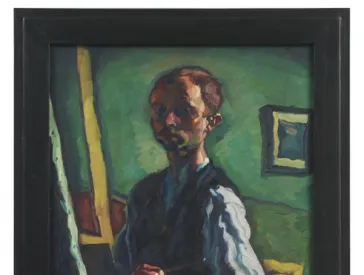
Self-Portrait at the Easel, Painting by Ludwig Meidner

Object Showcase

Self-Portrait at the Easel was painted at a turning point in the work of Ludwig Meidner (1884–1966), one of the most prominent Jewish members of the Expressionist movement.

Ludwig Meidner: Self-Portrait at the Easel, 1912, oil on canvas, 89.80 x 69.00 x 2.30 cm 
© Ludwig Meidner Archive, Jewish Museum Frankfurt, photo: Jens Ziehe

Die Pathetiker as Artistic Defiance

In November 1912, Meidner took part in a joint exhibition at Herwarth Walden’s gallery Der Sturm alongside Jakob Steinhardt and Richard Janthur. The three artists styled themselves as Die Pathetiker (The Men of Pathos) and, as the writer Kurt Pinthus recalled, flew the banner of a “new pathos:”

“through one fiery outburst of hyperbolic expression, they [sought] to blow open outmoded forms in art and society […] in order to create something that was new and, we believed, better, forged by hearts with faith in the future and an ‘industrious spirit’.” 

Meidner’s life and work were both shaped by the connection between artistic, social, and religious upheaval. He evolved from an anarchist revolutionary into a religious mystic and eventually became a strictly observant Jew, creating paintings on biblical themes.

Ludwig Meidner (1884–1966)

More on Wikipedia 
More on LeMO (in German)

Gallery Der Sturm

The Der Sturm gallery was founded in Berlin in 1912 by Herwarth Walden and became a center of Expressionist and avant-garde art in Germany. 
More on the website of the Staatliche Museen zu Berlin (in German)

Meidner’s Self-Portraits 

Meidner’s many self-portraits expressed his ongoing self-interrogation as an artist. He experimented in these works with a variety of roles and points of reference, presenting himself in turns as indecisive, demonic, or brash. In Self-Portrait at the Easel, he gazes at the viewer with confidence. 

The composition follows the conventions of an artist’s portrait, showing Ludwig Meidner in the act of painting. Nevertheless, the work clearly departs from studied precedent. Its expressive painterly gestures, with vigorous brushstrokes, angular and exaggerated shapes, and intense, even garish colors, give the painting a dynamic restlessness. Even while engaging with this traditional genre of portraiture, Meidner’s expressive formal language clearly transgresses its usual boundaries. 

Title

Selbstporträt an der Staffelei  (Self-Portrait at the Easel)

Artist

Ludwig Meidner (1884–1966)

Collection

Visual Art

Date

1912

Material

Oil on canvas

Dimensions

89 x 69 cm

Acquisition

Purchased with funds from the Stiftung Deutsche Kassenlotterie Berlin

Selected Objects: Fine Arts Collection (14)

  • Fine Arts Collection

    Glance through our art holdings featuring modernist works by Max Liebermann and Lovis Corinth, and commercial graphic art by Louis Oppenheim. The motifs span from biblical and Jewish themes to intimate portraits and Felix Nussbaum’s haunting response to his experience of persecution.

  • Painting of Albertine Mendelssohn-Bartholdy.

    Albertine Mendelssohn-Bartholdy as a Bride by August Theodor Kaselowsky

    In this painting, Albertine Heine appears to be a Christian Madonna. She holds the ring near her heart, wearing a white dress with her gaze modestly lowered.

    Object Showcase

  • Map of the Holy Land with English and Hebrew labels.

    Biblical map of the Holy Land

    This "New and Original Biblical Map of the Holy Land" from 1893 was probably never intended to be used by pilgrims or travelers on the ground.

    Object Showcase

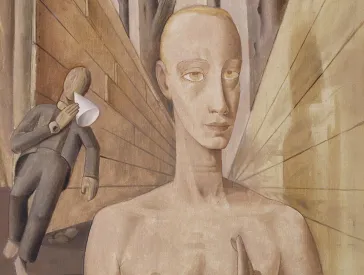
  • Painting, a man walks down a hallway.

    Loneliness by Felix Nussbaum

    Nussbaum is nearly unique among artists for his striking examination of his plight as one of the persecuted. He painted it in Brussels, where he was in hiding, in 1942.

    Object Showcase

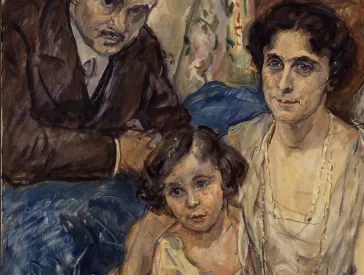
  • Painting shows a family of father, mother and child.

    The Plesch Family Portrait by Max Slevogt

    Max Slevogt created this painting of his friend's family in 1928. It captures the intimacy of family life while fulfilling a group portrait's representative function.

    Object Showcase

  • Abstract painting in blue, black and yellow tones

    Composition by Otto Freundlich

    Otto Freundlich painted this abstract composition in 1938 – one year after another artwork of his had been branded "degenerate art" in Nazi Germany.

    Object Showcase

  • Painting shows the outline of a man.

    Moses Looks upon the Promised Land by Lesser Ury

    For artist Lesser Ury, the painting marked the end of a lifelong preoccupation with the figure of Moses. Unfortunately, only a pastel sketch for the painting survives.

    Object Showcase

  • Portrait of a woman (Charlotte Berend) sitting in three-quarter profile on a red armchair in front of a window.

    Petermannchen by Lovis Corinth

    Lovis Corinth painted this portrait of his student and wife-to-be during a beach vacation on the Baltic coast. It contains a secret romantic message.

    Object Showcase

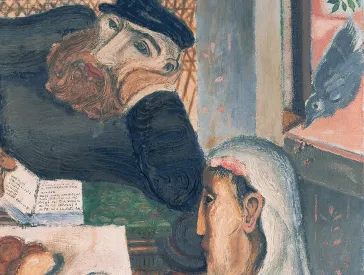
  • Detail from an oil painting with a lying man with a book in his hand and a woman with a headscarf at the table.

    Sabbath by Jankel Adler

    Jankel Adler's painting Sabbath shows a parlor scene on the weekly day of rest. But the artist has not depicted the festive, pleasurable moment of welcoming the Shabbat.

    Object Showcase

  • Bronze statue of a naked girl.

    Girl Walking by Elisabeth Wolff

    The sculpture by Elisabeth Wolff was a trophy at the first sporting festival held by the Reich Committee for Jewish Youth Associations, in 1934. The artwork has only been entrusted to our collection for safekeeping.

    Object Showcase

  • Painting of a man wearing a suit and a straw hat.

    Self-Portrait with Straw Hat by Max Liebermann

    In this late self-portrait, the artist presents himself as bourgeois in a dark suit and a Panama hat. Two years after his eightieth birthday, he painted himself here with a touch of resignation and melancholy.

    Object Showcase

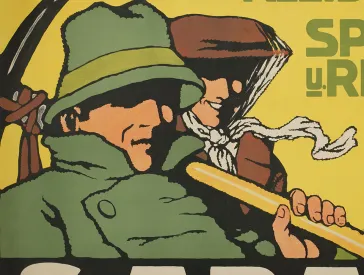
  • Color lithograph print: Louis Oppenheim, advertising poster for S. Adam.

    S. Adam Advertising Poster by Louis Oppenheim

    With this poster by the well-known graphic artist Louis Oppenheim, the S. Adam clothing store advertised its products to male and female sports enthusiasts in 1908.

    Object Showcase

  • Print: a man stands in a crowd of people.

    Passage through the Red Sea by Jakob Steinhardt

    This woodcut by Jakob Steinhardt illustrates a 1920s Haggadah. The people barely escaped with their lives—as is revealed in the expression on Moses’ face.

    Object Showcase

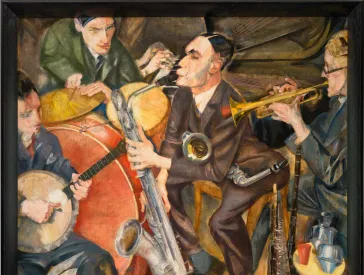
  • Cubist-inspired painting of a jazz band with saxophonist, trumpeter, drummer, guitarist and hands on the piano in the background.

    Painting Jazz

    How music became visible in Max Oppenheimer’s Jazzband (Weintraubs Syncopators)

    Object Showcase
    1927

  • Oil painting in dark colors showing a painter holding a brush, seated in front of an easel, looking at the viewer.

    Self-Portrait at the Easel Painting by Ludwig Meidner

    With vigorous brushstrokes and intense colors, Ludwig Meidner presents himself in this self-portrait as a modern artist

    Object Showcase
    1912