Painting Jazz
Object Showcase: Max Oppenheimer’s Jazzband (Weintraubs Syncopators), 1927
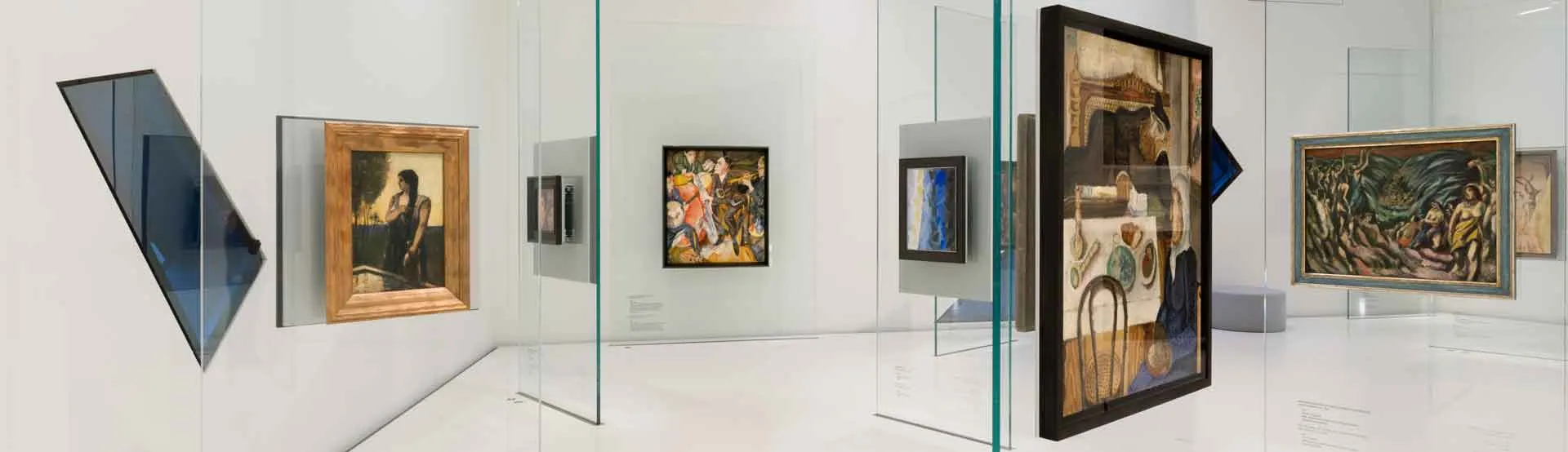
Exhibition view of the core exhibition featuring Max Oppenheimer's Weintraubs Syncopators in the Art and Artists theme room; Jewish Museum Berlin, photo: Roman März
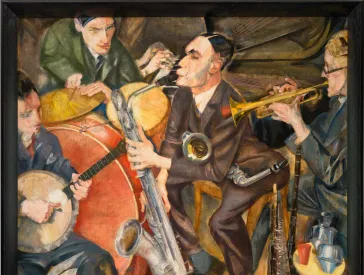
The viewer’s eye is drawn immediately to the bright red drum set with its golden bass drum and the silver saxophone jutting out in front. They are flanked by a banjo on the left and a trumpet on the right. The instruments are being played by members of one of the leading jazz and show bands in 1920s Berlin: the Weintraub Syncopators. Austrian artist Max Oppenheimer has crowded them tightly in the square of the painting.
The band’s name refers to its founder, Stefan Weintraub, and the offbeat rhythm known as syncopation. Weintraub Syncopators started out in 1924 as a school band. By the time Oppenheimer painted them in 1927, they were widely known after radio performances for the Berlin broadcaster Funkstunde, and were well on their way to becoming stars of the city’s nightlife.
Max Oppenheimer (1885–1954): Jazzband (Weintraubs Syncopators), oil on wood, 1927, Jewish Museum Berlin, previously Sammlung Hugo Staub, forcibly appropriated in 1933, privately owned from 1962, acquired by the JMB after a fair and equitable agreement was reached through the mediation of the Grisebach auction house, purchase funded from a bequest by Gisela Schwandt to the Deutsche Bank Foundation; Jewish Museum Berlin, photo: Roman März
From Dance Band to Show Band
The band’s founders dominate the pictorial space: Stefan Weintraub on the drums and Horst Graff on the big baritone (or bass) saxophone, his long legs stretched outward. To the right, we see Ansco Brunier on trumpet; to the left, Paul Aronovici plays the banjo. Only the player’s hands are visible at the open grand piano in the background, probably because, after several changes to the lineup around the time the painting was made, Stefan Weintraub played both piano and percussion. Friedrich Hollaender worked with the Syncopators only briefly and Franz Wachsmann did not join until later.
The sheets of music slipping to the floor, the alto saxophone tucked under Horst Graff’s arm, the other wind instruments – a soprano saxophone and two clarinets – ready and waiting, and the mutes on the table and floor convey a sense of the band’s dynamic style: the band members switched their instruments at lightning speed, sometimes even playing on kitchen utensils. Clowning, pantomime, and acrobatics were the hallmarks of the Syncopators. They performed in several of Hollaender’s cabaret shows from spring 1927 onward and evolved from a purely dance band to a show band.
Starting in 1927, the Syncopators recorded German hits that are still familiar today, with titles such as
Am Sonntag will mein Süsser mit mir Segeln gehen (“My Sweetheart Wants to Take Me Sailing on Sunday”), Mein Gorilla hat ‘ne Villa im Zoo (“My Gorilla Has a Villa at the Zoo”) and Nimm Dich in Acht vor blonden Frau‘n (“Beware of Blondes”). They appeared in films including The Blue Angel and toured internationally. In 1933, the musicians, almost all of them Jewish, decided not to return to Germany after a tour abroad. They tried to find their feet in Australia, but without success; in the end, the band dissolved.
The painter Max Oppenheimer had already left Germany in 1932, alarmed by the political situation. In exile in New York, he was unable to build on his earlier success. He died there in 1954.
How Can Music Be Painted?
Max Oppenheimer lived in Berlin from 1912 to 1915, then again from 1925 to 1931. His first successes were in Vienna, with psychologically astute portraits of painters, poets, and musicians, but from 1914, he started to portray musicmaking itself. Oppenheimer was a talented violinist, the owner of a Nicola Amati violin, and began by painting mainly string players and string quartets – examples are Hess Quartett (1914, now lost) and Rosé Quartett (1925, held by the Germanisches Nationalmuseum in Nuremberg) – along with Ferruccio Busoni at the Piano (1916, Nationalgalerie SMB and Akademie der Künste, Berlin), before turning to the Weintraub Syncopators in 1927.
For this painting, he adopts a style that combines futurism with New Objectivity. The faces have a portrait-like reality with a degree of modernism, but to translate jazz music’s polyphony and rhythm into the medium of painting, Oppenheimer uses Cubism-inspired cuts, faceting, and diagonally overlapping planes. He saw these as “lines of force” that gave expression to “dynamic sensations.” Whereas Oppenheimer’s portrayals of classical musicians were dominated by shades of brown and cream, in Jazzband he uses vibrant reds and yellows to evoke the rapid tempo, volume, and energy of the music.
In the second half of the 1920s, Oppenheimer became interested in the themes of contemporary big-city life, sport, and the modern professions. Jazzband is his only painting in the domain of popular music and one of very few artistic representations of jazz to have been made so early in the century. Unlike fellow artists such as Otto Dix, George Grosz, and Max Beckmann, Oppenheimer does not use jazz as an emblem of modern urban life with its ambivalent oscillation between the thrill of novelty and the stress of noise, haste, social conflict, even moral decay. Nor does he accept the association of jazz with Africa and Black musicians, which had become a stubborn cliché by the 1920s.
Instead, analogously to his portrayals of string quartets, Oppenheimer’s artistic interest here is in one specific jazz band, and in translating into paint the dynamism of its specific musical sound and style of playing. By employing similar techniques for both classical chamber music and jazz, Oppenheimer gives jazz equal status as a new form of ensemble musicmaking.
The Painting’s Trail
Jazzband was exhibited soon after it was painted, in two shows at Alfred Flechtheim’s galleries in Berlin and Düsseldorf, and reached a wider audience through reproductions in Flechtheim’s journal Der Querschnitt and the arts magazine Die Horen. The Syncopators reproduced the picture to advertise their performances, and in 1929/1930, the painter and stage designer Sascha Wiederhold used a copy in one of his set designs.
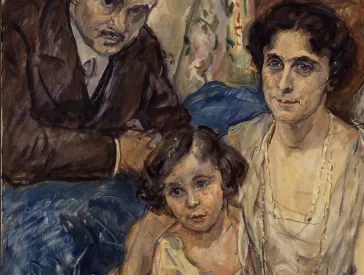
By 1930, the painting was in the possession of Hugo Staub, a lawyer and psychoanalyst. Staub knew Max Oppenheimer personally, as is evidenced by the portrait of Staub’s wife and child that Oppenheimer painted, also in 1927 (Mutter und Kind, Puttkamer no. 176).
As a Jew and a member of the German League for Human Rights, Staub was a target for the Nazis early on. He fled Germany in 1933, first to France and Britain, then to the United States, where he died in 1942. He left the painting behind in his Berlin apartment. Even today, we do not know exactly what happened to the work until 1962, when it reappeared on the art market in Berlin and was bought by the son of an architect who had emigrated from Berlin. It was from this purchaser’s heirs that the Jewish Museum Berlin (JMB) acquired the painting in 2024, with the agreement of Hugo Staub’s heirs and after a fair and equitable settlement had been reached. Since then, it has been on show in the museum’s core exhibition.
Inka Bertz, curator for Fine Arts (until 2025)
|
Title |
Jazzband / Weintraub Snycopatos |
|---|---|
|
Artist |
Max Oppenheimer (1885–1954) |
|
Collection |
Fine Arts |
|
Year of origin |
1927 |
|
Medium |
Oil on canvas |
|
Dimensions |
123,3 x 118,4 x 3,6 cm |
|
Acquisition |
originally the property of Dr. Hugo Staub, who was stripped of ownership in 1933; purchased by a private party in 1962. Acquired by the JMB in 2024 following a just and fair solution facilitated by the Grisebach auction house, with funds from a bequest by Gisela Schwandt to the Deutsche Bank Foundation |
Citation recommendation:
Inka Bertz (2021), Painting Jazz. Object Showcase: Max Oppenheimer’s Jazzband (Weintraubs Syncopators), 1927.
URL: www.jmberlin.de/en/node/10632